
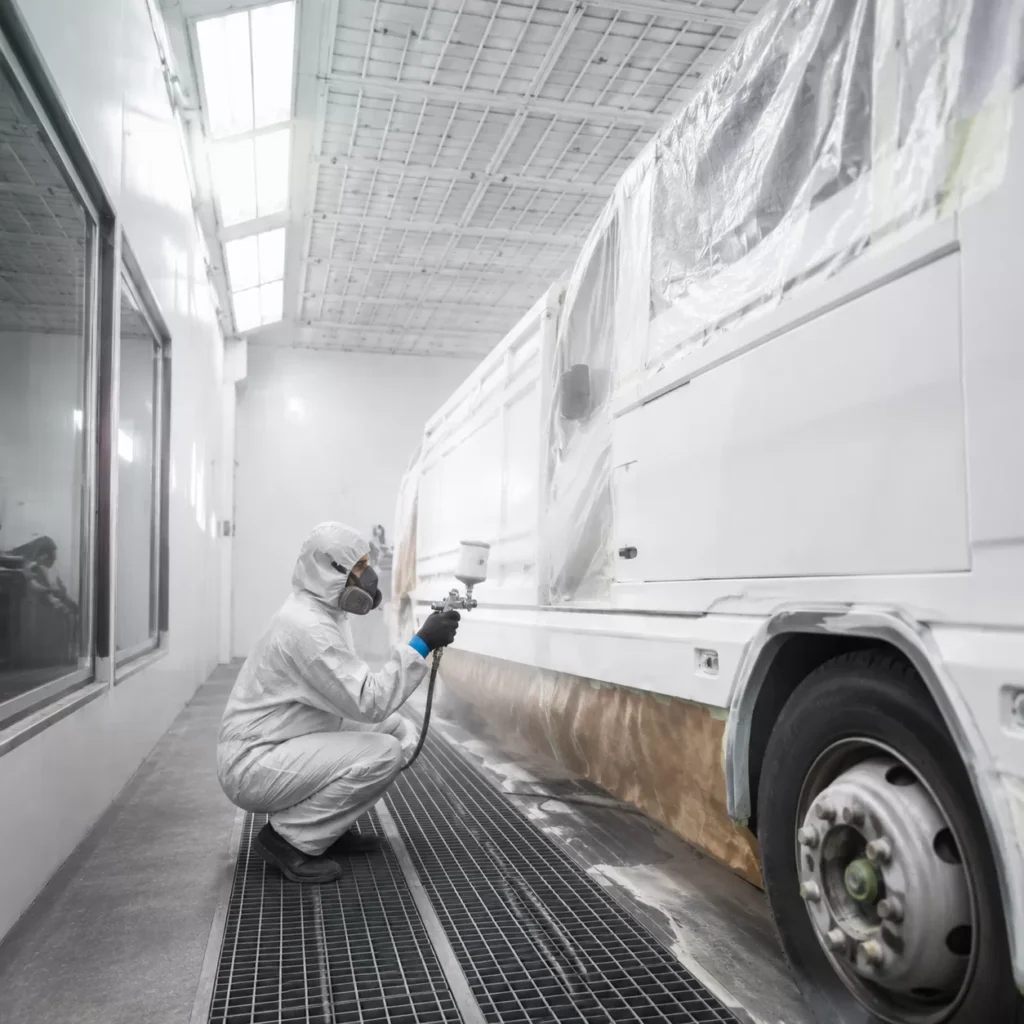
If your trucks are sitting at a third-party shop waiting for a paint job, they’re not making you money. For fleet operations running commercial vehicles day in and day out, outsourcing refinishing work is one of the easiest costs to eliminate — and one of the most overlooked. A dedicated fleet maintenance paint booth puts scheduling, quality, and cost back in your hands. This guide covers what that shift looks like in practice, what to look for in a booth built for heavy vehicles, and how to set your shop up to actually get the most out of it.
Page URL: https://sprayboothmanufacturer.com/product/
Why In-House Refinishing Makes Sense for Fleets
The Real Cost of Outsourcing
Sending trucks to an outside shop costs more than just the invoice. There’s the transport time, the vendor backlog, the markup on labor and materials, and the days your asset spends sitting idle instead of working. For a fleet where uptime is directly tied to revenue, a 7 to 14 day turnaround at an outside shop is a real operational hit.
Bringing refinishing in-house cuts that turnaround to one to three days. Your trucks go to the front of the line every time because the line is yours. And you stop paying for someone else’s overhead and profit margin on every job.
| Cost Factor | Outsourced Refinishing | In-House Booth |
|---|---|---|
| Vendor Markup | 25–40% | None |
| Average Downtime | 5–10 Days | 1–3 Days |
| Quality Control | Limited | Full control |
| Transport Cost | High | Zero |
Brand Consistency Across the Fleet
Your trucks are on the road every day representing your business. A faded cab, a mismatched panel, or a worn logo wrap doesn’t go unnoticed. With your own booth, you control the color standards and finish quality for every vehicle in the fleet — not a vendor who’s balancing your job against a dozen others.
This matters especially for large fleets where vehicles get repainted at different times. Without a controlled environment and consistent process, small color variations add up across the lineup.
What to Look for in a Heavy-Duty Fleet Booth
Size and Clearance
Standard automotive booths aren’t built for Class 8 trucks, box trucks, or long trailers. The dimensions are simply wrong. For commercial fleet work, you need a booth that fits the actual vehicles you’re running — our configurations cover vehicles from 10 to 15 meters in length, which handles most semi-tractors, delivery trucks, and larger vans without compromise.
Practical minimums for heavy fleet work:
- Length: 50 to 60 feet for a full tractor-trailer setup
- Width: 16 to 20 feet to give painters room to move freely
- Height: 16 to 18 feet to clear high-roof sleepers and stacks
Always add a few feet around the exterior footprint for mechanical units, filtration housings, and suppression equipment.
Airflow System Options
The airflow design affects finish quality more than most people expect. Two common options for fleet-scale booths:
| Feature | Crossflow | Downdraft |
|---|---|---|
| Air Path | Front to back across the vehicle | Ceiling down to floor exhaust pits |
| Contamination Risk | Moderate — overspray can drift to the rear | Low — overspray pulled away immediately |
| Installation Cost | Lower — no pit required | Higher — requires concrete work |
| Best For | Maintenance and utility fleets | High-quality finish work |
For fleet shops focused on getting vehicles back in service quickly rather than showroom-level finishes, crossflow is often a practical and cost-effective choice. For operations where finish quality is a brand priority, downdraft gives better results on large vertical surfaces.
Curing and Heat Systems
Air drying at production volume is slow. Heated air makeup units keep the booth at a consistent working temperature regardless of season, which matters in winter when cold metal panels affect how paint flows and bonds. Recirculation mode during the bake cycle reuses heated air rather than exhausting it — which makes a significant difference in gas consumption when you’re heating a space sized for a 12-meter truck.
Compliance and Safety
What the Regulations Require
Fleet refinishing operations in the US need to meet EPA 6H NESHAP requirements for hazardous air pollutants, OSHA ventilation standards for worker safety, and NFPA 33 for fire-rated construction and operational safety. These aren’t optional and they’re not difficult to meet if your booth is built to the right spec from the start.
Every booth we build includes explosion-proof lighting and motors, adequate ventilation rates for the booth volume, and multi-stage filtration to manage VOC emissions and overspray.
| Requirement | Standard | What It Covers |
|---|---|---|
| Emission Control | EPA 6H NESHAP | VOC and particulate limits |
| Worker Safety | OSHA Ventilation | Air quality for painters |
| Fire Prevention | NFPA 33 | Construction and operational safety |
Fire Suppression
Any booth spraying flammable finishes needs an integrated fire suppression system — this is a hard requirement under NFPA 33 and OSHA. For fleet shops where the vehicles themselves may carry fuel or hazardous materials, a dry chemical or gaseous system is the standard choice. These trigger automatically and shut down fans and burners at the same time to limit spread.
Setting Up Your Shop for Efficiency
Layout Comes First
A well-specced booth in a poorly planned shop still creates bottlenecks. The goal is a clean flow from prep to booth to staging — vehicles move through in one direction without backtracking or maneuvering around equipment.
Keep sanding and masking areas close to the booth entrance. Make sure there’s enough clearance for larger rigs to turn in and out without a complicated sequence of moves. Store your paint mixing station and materials close to the booth so technicians aren’t walking back and forth across the shop floor between coats.
Routine Maintenance Keeps the Booth Productive
An unmaintained booth is an unreliable booth. Filter changes, seal checks, and burner servicing on a regular schedule prevent the unplanned failures that take a booth offline during a busy week.
| Task | Frequency | Why It Matters |
|---|---|---|
| Filter Inspection | Weekly | Maintains airflow, protects the motor |
| Seal and Gasket Check | Monthly | Prevents dust leaks and contamination |
| Burner and Heater Service | Annually | Keeps cure times consistent |
| Floor Cleaning | Daily | Reduces dust nibs in the finish |
FAQ
How much space do I actually need for a semi-truck booth? For a full tractor-trailer, plan on at least 50 to 60 feet of length, 16 to 20 feet of width, and 16 to 18 feet of ceiling height. Add 3 to 5 feet around the exterior for mechanical equipment. Our standard fleet configurations cover vehicles up to 15 meters — which handles most Class 8 tractors and heavy delivery vehicles comfortably.
What ventilation rate is required for commercial fleet work? Most codes require a minimum of 100 lineal feet per minute of airflow across the work area. For large vehicles, that means heavy-duty centrifugal or axial fans capable of handling the static pressure created by a fully loaded filtration system. Intake filtration is equally important — unfiltered air in a large booth means contamination in the finish.
How often do filters need to be replaced in a high-volume shop? Intake filters typically last two to four months under production load. Exhaust filters should be checked every 50 to 100 operating hours. Floor or pit filters need weekly attention in busy shops — a manometer reading higher than baseline is the clearest sign they need to be changed.
Does my booth need a fire suppression system? Yes, without exception. Any spray booth using flammable finishes must have an integrated suppression system to meet NFPA 33 and OSHA requirements. This protects your facility, your crew, and your compliance record.
Tell Us What You’re Working With
Share your fleet size, the types of vehicles you’re refinishing, and your current setup — or lack of one. We’ll put together a booth recommendation and a detailed quote for your specific operation, usually within 48 hours.
Related Pages
- Bus Spray Booth Design Guide → https://sprayboothmanufacturer.com/transit-coach-spray-booth-requirements/
- Truck Paint Booth Guide → https://sprayboothmanufacturer.com/truck-paint-booth-semi-truck-spray-booth-specifications-buying-guide/
- Other related products → https://www.autokemanufacture.com/product
- Contact our sales Team → https://sprayboothmanufacturer.com/contact-us/
✅ CE Certified | ✅ ISO 9001:2015 | ✅ Factory Direct | ✅ Ships to 60+ Countries | ✅ 1-Year Warranty | 🔒 HTTPS Secured