
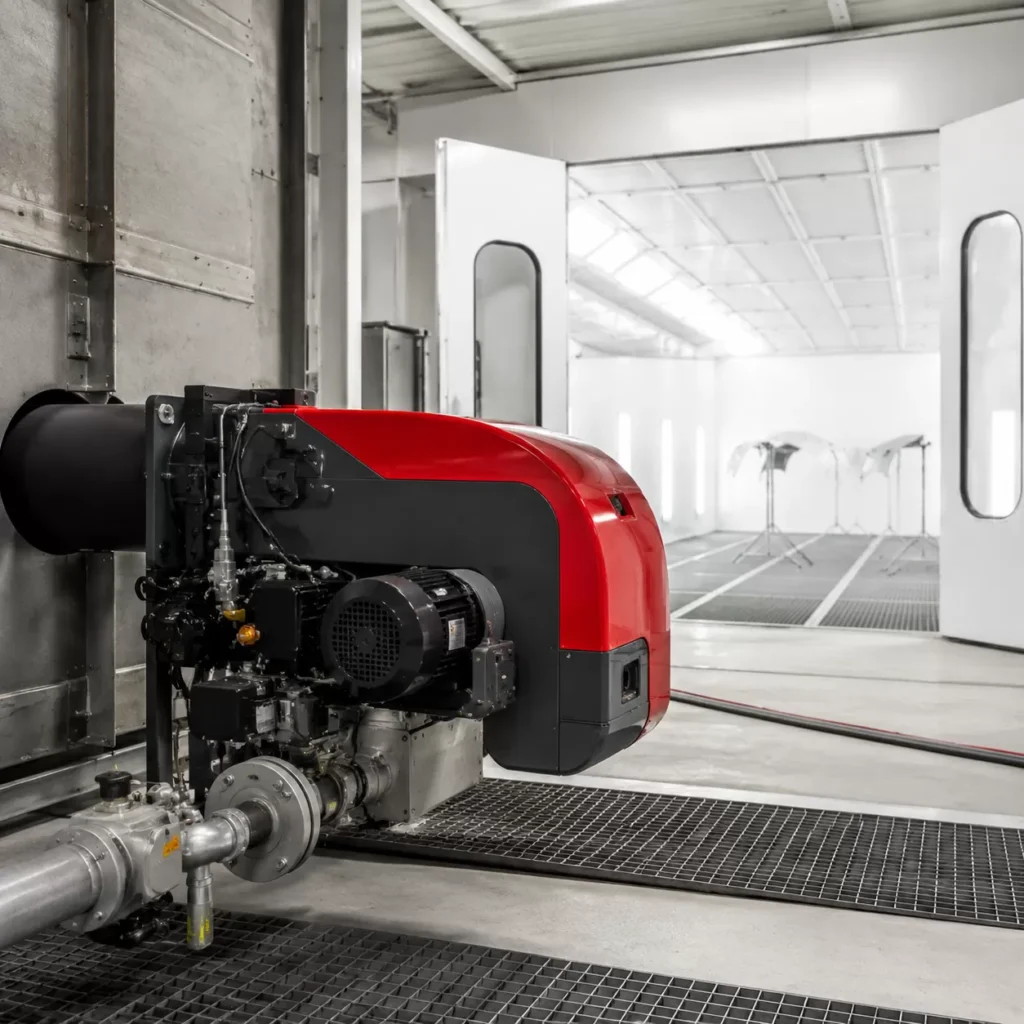
Most shops spend serious money on spray guns and premium coatings, then put a budget burner in charge of the curing process. That’s where defects come from. Solvent pop, dieback, uneven gloss — these problems get blamed on the paint or the painter, but the real cause is usually the heating system failing to maintain the precise conditions the curing chemistry requires. This guide covers how the burner actually affects your finish, what inferior combustion does to paint, and why the RIELLO G20 is the standard we build around at AUTOKE.
Page URL: https://sprayboothmanufacturer.com/product/
What the Burner Actually Does in a Paint Booth
The burner doesn’t just produce heat — it controls the chemical environment that determines whether the paint cures correctly or fails. Once the final coat is applied, the booth transitions from spray mode to bake cycle, and that transition needs to happen in a precise, controlled way. If the heat ramps too fast, the top layer of clear coat skins over before solvents have escaped, trapping them underneath. If the heat ramps too slowly, the flash-off window closes before the chemistry can complete properly. Either way, you get defects.
Controlled Solvent Evaporation
Gradual, steady heat allows solvents to flash off naturally through the still-open surface of the paint. A burner that overshoots the target temperature — even briefly — triggers early surface sealing. Solvents trapped beneath a hardened top layer have nowhere to go except outward, which is what causes pinholing and solvent pop during the bake cycle.
Clear Coat Cross-Linking
A durable, glossy clear coat finish requires sustained temperature at the correct level throughout the entire bake cycle. The cross-linking reaction — where the molecules in the paint film bond tightly together to form a hard, scratch-resistant layer — only happens within a specific temperature window and requires that temperature to be held consistently. A burner that drifts above or below that window interrupts the reaction and produces a finish that looks right in the booth but fails early in the field.
Heat and Airflow Working Together
Heat generation alone isn’t enough. The booth’s airflow system needs to distribute that heat evenly across the entire vehicle surface — from the roof panels to the rocker panels — at the same rate. When the burner maintains precise output and the airflow is calibrated correctly, every panel cures at the same speed. Cold spots from inconsistent burner output are what cause uneven gloss across the vehicle, where some panels cure properly and others don’t.
Why the Burner Brand Actually Matters
Not all burners hold temperature the same way, and the difference shows up directly in the paint.
Temperature Stability
Cheap burners struggle to lock onto and hold a target temperature. They overshoot, then drop back, then overshoot again. Those fluctuations aren’t harmless — each one disrupts the curing chemistry happening on the vehicle surface. A paint baking cycle that runs through repeated temperature swings produces inconsistent results that vary from job to job even when the paint, prep, and technique are identical.
Combustion Quality
Budget burners frequently suffer from incomplete combustion — the fuel doesn’t burn cleanly, leaving unburned byproducts in the exhaust stream. In a system where the air from the burner circulates through the cabin, those combustion byproducts become airborne contaminants that land on wet clear coat. The soot or micro-residue that comes from a dirty burn creates exactly the kind of contamination problem that looks like a filtration failure but is actually a combustion failure.
Ramp-Up Speed and Consistency
How fast and how smoothly the burner reaches bake temperature matters for the chemistry of the flash-off phase. If the burner lags and takes too long to climb to the set point, the paint film starts to cure while still at a temperature that traps volatiles rather than releasing them. A burner that ramps up quickly, smoothly, and predictably ensures the transition from spray to cure happens on schedule every time.
What Inferior Burners Do to Paint: Three Specific Defects
Solvent Pop and Pinholing
When an uncontrolled burner dumps too much heat too quickly, the surface of the clear coat cures before the solvents beneath it have flashed off. As the cabin continues to heat, those trapped solvents expand and push through the partially cured surface, creating tiny holes or craters across the clear coat. Once the surface is sealed, there’s no fixing solvent pop without stripping and repainting. The only reliable prevention is a burner that ramps up smoothly and holds the set temperature without spikes.
Uneven Gloss and Dieback
Inferior burners produce inconsistent heat output, which means some panels get more heat than others during the bake cycle. Panels that cure at a lower temperature or more slowly than the rest don’t develop the same level of gloss — as the vehicle cools, the variation becomes visible as mismatched sheen across different areas of the car. This dieback problem is almost always traced back to cold spots caused by poor heat distribution, which is a direct result of unstable burner output.
Loss of Adhesion
Proper cross-linking requires that the target temperature be reached and sustained for the full duration of the bake cycle. A cheap burner that can’t reach the set temperature quickly enough, or that drops off temperature partway through the cycle, produces a finish that hasn’t fully bonded. The paint may look acceptable leaving the booth but will peel or flake prematurely under normal service conditions. The customer comes back. The shop absorbs the cost.
The RIELLO G20: Why This Specific Burner Is the Standard
The RIELLO G20 is an Italian-engineered gas burner designed specifically for the thermal demands of industrial heating applications — including the precise temperature control and combustion efficiency that automotive paint curing requires. There’s a reason it’s the standard specification in serious production booths rather than a premium option.
Pinpoint Temperature Control
The G20 holds exact set temperatures with minimal variance. For a paint baking cycle, that means the booth reaches target temperature on schedule and stays there throughout the cure without the fluctuations that cheaper units produce. The cold spots that cause dieback simply don’t happen when the heat output is this consistent.
Clean Combustion
RIELLO engineering produces a complete, clean burn. There are no unburned fuel byproducts entering the air stream, which means no combustion-sourced contamination reaching the wet paint surface. For shops that have chased contamination issues through filter changes and cleaning protocols without finding the source, combustion quality is often what they haven’t looked at yet.
Fuel Efficiency and Operating Costs
Clean, complete combustion also means better fuel efficiency. The G20 extracts maximum heat value from the gas being burned rather than passing unburned fuel through the system. In a high-production shop running multiple bake cycles per day, that efficiency difference translates directly to lower monthly gas bills — not as a small incremental improvement, but as a consistent operating cost reduction across every cycle the booth runs.
Reliability Under Production Load
High-volume collision centers and industrial finishing operations can’t afford unplanned burner downtime. The G20 is built for continuous production use rather than intermittent light-duty applications. Maximum uptime isn’t a marketing claim — it’s what the design is engineered around.
How AUTOKE Integrates the RIELLO G20
Bolting a quality burner onto a generic enclosure doesn’t produce the results the burner is capable of. At AUTOKE, the airflow dynamics, insulated ducting, and control panel logic are designed around the thermal output profile of the RIELLO G20 rather than adapted to it after the fact. The heat the G20 produces gets distributed through the cabin in a way that takes full advantage of its consistency and precision.
The control panel synchronizes the burner’s ramp-up with the booth’s ventilation transition from spray mode to bake cycle. The insulated panels retain heat efficiently during the cure phase, which means the G20 isn’t working against heat loss through the walls. Every element of the system is calibrated to support what the burner is doing rather than working independently of it.
The ROI Case
For a high-production operation, upgrading to a system built around the RIELLO G20 produces measurable returns in three areas.
Faster cycle times come from the G20’s quick, consistent ramp-up to target temperature. More bake cycles per shift means more vehicles delivered per day. Reduced rework comes from eliminating the temperature instability that causes solvent pop, dieback, and adhesion failures — each avoided redo represents several hours of labor and materials that go directly back to the margin. Lower operating costs come from the G20’s combustion efficiency over every cycle the system runs.
The upfront cost of proper equipment is fixed. The ongoing cost of inferior equipment shows up on every job.
Common Questions
Why does temperature stability matter so much for clear coat? Clear coat cross-linking is a chemical reaction that happens within a specific temperature range. Below it, the reaction doesn’t complete and the finish won’t be durable. Above it — particularly during early ramp-up — the surface seals prematurely and traps solvents. The RIELLO G20’s precise temperature control keeps the cure in the right range throughout the bake cycle.
Can combustion quality really cause contamination in the finish? Yes. Incomplete combustion produces particulate byproducts in the exhaust stream. In a recirculating bake cycle, that material gets distributed through the cabin. The result looks like filtration contamination but doesn’t respond to filter changes because the source is the burner, not the intake air. Switching to a clean-burning unit like the G20 eliminates this source entirely.
How does burner quality affect waterborne coatings specifically? Waterborne coatings require controlled heat during flash-off to drive water evaporation without sealing the surface early. The same temperature stability that prevents solvent pop in solvent-based clear coats is what allows waterborne coatings to flash cleanly. An unstable burner is particularly problematic with waterborne systems because the margin for error in the flash-off phase is narrower.
Tell Us What You’re Working With
Share your current heating setup, production volume, and any recurring finish quality issues you’re dealing with. We’ll help identify whether a burner upgrade addresses the root cause and send a detailed equipment quote — usually within 48 hours.
Related Pages
- Bus Spray Booth Design Guide → https://sprayboothmanufacturer.com/transit-coach-spray-booth-requirements/
- Truck Paint Booth Guide → https://sprayboothmanufacturer.com/truck-paint-booth-semi-truck-spray-booth-specifications-buying-guide/
- Other related products → https://www.autokemanufacture.com/product
- Contact our sales Team → https://sprayboothmanufacturer.com/contact-us/
✅ CE Certified | ✅ ISO 9001:2015 | ✅ Factory Direct | ✅ Ships to 60+ Countries | ✅ 1-Year Warranty | 🔒 HTTPS Secured