
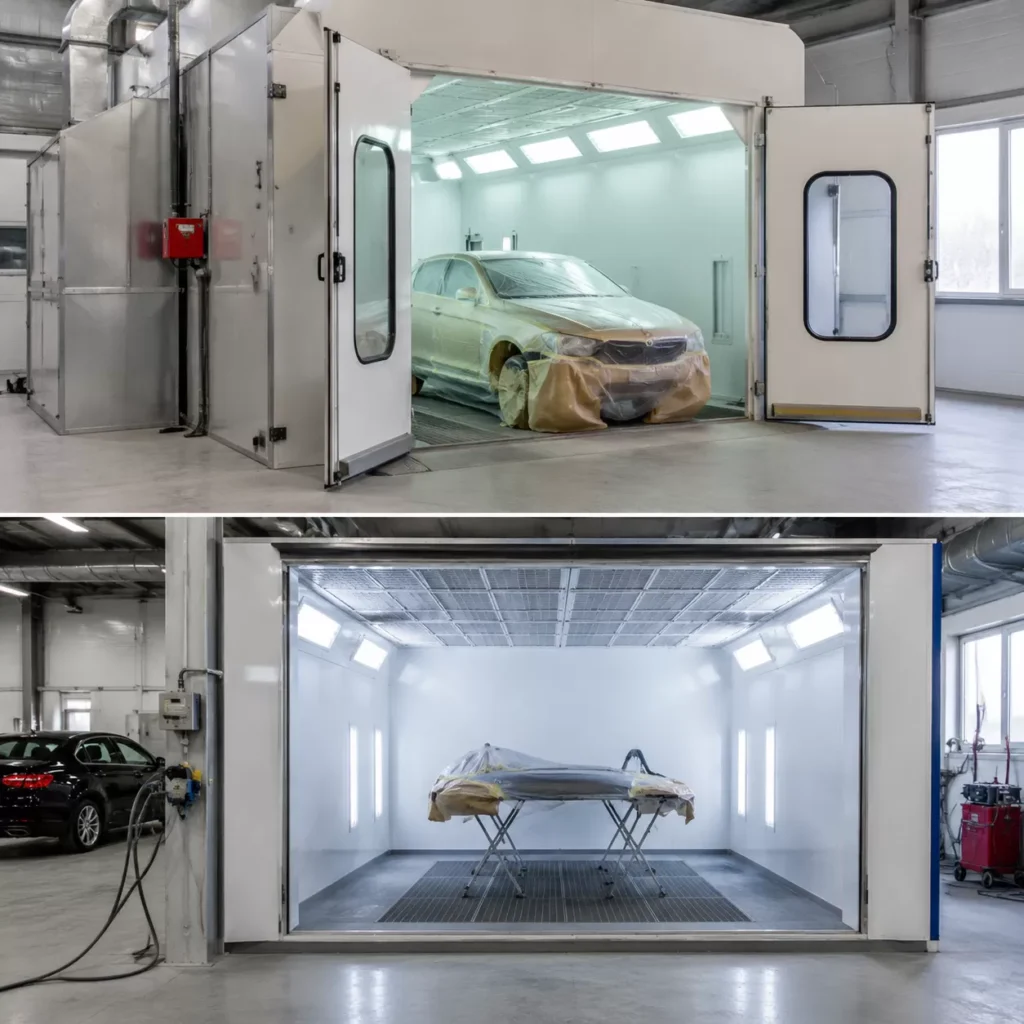
These two pieces of equipment look similar from the outside and often get used interchangeably in conversation, but they do fundamentally different jobs. One is built for applying paint cleanly. The other is built for curing it quickly. Understanding the difference is what helps you figure out which setup your shop actually needs — and whether a combination unit makes more sense than running both separately.
Page URL: https://sprayboothmanufacturer.com/product/
What a Paint Booth Does
A paint booth’s job is contamination control. It provides a clean, dust-free environment for applying automotive coatings while safely removing hazardous VOCs and overspray from the spray zone. The design is focused entirely on keeping the air clean during the application process and protecting the painter from fumes.
Airflow Configurations
How air moves through the booth determines how effectively it does that job.
Crossdraft is the most economical setup. Air enters through front intake filters and travels horizontally to an exhaust plenum at the rear. It works, but overspray has to travel across the full length of the vehicle before reaching the exhaust — which means more exposure time and a higher contamination risk on longer vehicles.
Semi-downdraft is a step up. Air enters through ceiling filters at the front and exits at the lower rear wall, creating a diagonal flow that controls overspray better than a straight horizontal path. No floor excavation is required.
Downdraft is the gold standard for automotive refinishing. Air flows straight down from ceiling filters to a grated floor exhaust, pulling overspray away from both the vehicle surface and the painter at every point along the vehicle’s length simultaneously. It delivers the cleanest finishing environment of the three configurations.
The Limitation of Unheated Booths
A standard spray booth without a heating system is excellent at contamination control but does nothing to speed up drying. In an unheated booth, you’re entirely dependent on ambient shop temperature to drive paint drying — and ambient temperature is unpredictable. In cooler climates or on humid days, slow solvent evaporation creates a bottleneck that limits how many vehicles can move through the shop each day. For low-volume operations, this may be acceptable. For production shops, it’s a problem.
What an Automotive Paint Oven Does
An automotive paint oven — sometimes called a curing cabin — is built for a different phase of the process entirely. It’s not about applying paint cleanly; it’s about making the paint that’s already been applied cure faster and harder than it would under ambient conditions.
How Heat Accelerates Curing
The target temperature range for auto body paint baking is typically 140°F to 160°F. At those temperatures, two things happen that don’t occur at room temperature.
First, rapid evaporation. The heat drives off water or solvents from the coating much faster than ambient airflow does, so the paint sets without trapping moisture underneath.
Second, chemical cross-linking. The intense heat forces the molecules in the paint film to bond together tightly, producing a durable, scratch-resistant finish in a fraction of the time it would take to achieve naturally. This is what makes baked finishes more durable than air-dried ones — it’s a different chemical state, not just a faster version of the same process.
When a Standalone Curing Cabin Makes Sense
A dedicated curing cabin separate from the spray booth becomes a real asset in specific situations. High-production facilities that repair large numbers of vehicles each week can’t afford to have the spray booth tied up while a just-painted vehicle sits in it drying. Moving freshly sprayed vehicles into a dedicated curing space frees the booth up for the next job immediately. Similarly, large-scale commercial operations where the painting and baking phases need to run simultaneously across multiple vehicles benefit from physically separated spray and cure zones.
The Core Differences Side by Side
| Feature | Paint Booth | Automotive Paint Oven |
|---|---|---|
| Main Function | Dust-free spraying and ventilation | Accelerating the paint curing process |
| Airflow | Exhausts air outside | Recirculates hot air |
| Temperature | Ambient — room temperature | High heat — 140°F to 160°F |
| Energy Focus | Exhaust fan operation | Heating elements or burners |
The most important mechanical difference between the two is what happens to the air. A spray booth is designed to exhaust air out of the building — pulling overspray and VOCs away from the painter and out the exhaust stack. An automotive paint oven is designed to recirculate air. During the bake cycle, a curing oven recycles 80% to 90% of the heated air rather than exhausting it, which is how it maintains a consistent high temperature efficiently without running the burner constantly.
A standard unheated paint booth can’t do what an oven does. It lacks the burner system and the recirculation capability needed for a proper bake cycle. Blowing ambient air over a wet vehicle doesn’t trigger the chemical cross-linking that curing requires.
The Modern Standard: The Heated Spray Booth Combination Unit
For most auto body shops in the US, the practical answer to the booth vs. oven question is neither one in isolation — it’s a heated combo unit that handles both functions in a single bay.
How the Bake Cycle Works in a Combination Unit
When a technician finishes spraying, the system transitions directly from spray mode to cure mode.
First, a brief purge cycle clears residual airborne solvents from the cabin before the heat ramps up — this is a safety step that prevents igniting solvent vapor with the burner. Then the system switches to high recirculation mode, cycling 80% to 90% of the already-warmed air back through the heat exchanger rather than exhausting and replacing it. The cabin climbs to bake temperature quickly and maintains it throughout the cure cycle with significantly less fuel consumption than heating fresh cold air would require.
Why Combination Units Make Sense for Most Operations
Space efficiency. Running both spraying and curing in a single bay eliminates the need for a separate piece of equipment and the floor space it would occupy. For shops where every square foot of production space has a cost, this matters.
Workflow continuity. A freshly painted vehicle doesn’t need to be moved across the shop floor to a separate curing area — it goes directly into the bake cycle in the same environment where it was sprayed. Moving a wet vehicle introduces contamination risk. Staying in the same sealed environment eliminates it.
Waterborne paint compatibility. Waterborne coatings dry through water evaporation, not solvent volatility. They need both active airflow and controlled heat to flash off properly. An unheated booth produces unacceptably slow flash times with waterborne systems. A heated combination unit handles both the airflow and the temperature requirements that waterborne coatings demand.
Which Setup Does Your Shop Need?
The right answer depends on how your shop actually runs.
| Shop Factor | What It Means for Your Setup |
|---|---|
| Production Volume | High-output shops need rapid cure times. A heated unit is necessary to prevent the booth from becoming a bottleneck. |
| Floor Space | Tight shops can’t afford the footprint of both a separate booth and a standalone curing cabin. |
| Local Climate | Colder climates need a heating system just to maintain proper spray temperatures during winter. |
| Coating Type | Waterborne coatings require controlled heat and airflow — an unheated booth isn’t a workable option. |
For most modern collision repair operations, a high-quality heated spray booth is the most practical choice. It handles contamination control during application and transitions directly to a bake cycle when spraying is done, without moving the vehicle or changing environments. The ROI case is straightforward: faster cure times mean more vehicles through the shop each week, and fewer driveacross-the-shop moves mean less contamination risk on every job.
A standalone curing cabin makes more sense when the spray volume is high enough that a single combo unit can’t keep up — when you need the spray zone available for the next vehicle while the previous one is still curing. At that production level, physically separating the two phases is what keeps the line moving.
Common Questions
Can I use a standard paint booth as an oven? No. A standard unheated booth exhausts air rather than recirculating it, and it has no burner system. Without both of those elements, you can’t achieve or maintain the temperatures required for proper chemical cross-linking. What you’d end up with is ambient air flowing over a wet vehicle — which dries it slowly rather than curing it properly.
What temperature does a paint oven need to reach? The industry standard for auto body paint baking is 140°F to 160°F. This range is hot enough to drive off solvents or water quickly and trigger the cross-linking that makes the finish durable, but stays within safe limits for the vehicle’s plastic trim and interior components.
Do I need a heated booth if I’m running waterborne paint? Yes. Waterborne coatings dry through water evaporation, which requires active airflow and heat to happen at production speed. In an unheated booth with ambient airflow, flash times stretch dramatically — particularly on humid days or in cold weather. A heated booth with proper airflow dynamics is the practical requirement for waterborne systems, not an optional upgrade.
Tell Us What You’re Working With
Share your production volume, facility dimensions, coating type, and current equipment situation. We’ll help you determine whether a heated combo unit or a separate curing cabin better fits your operation — and send a detailed quote with layout drawings usually within 48 hours.
Related Pages
- Bus Spray Booth Design Guide → https://sprayboothmanufacturer.com/transit-coach-spray-booth-requirements/
- Truck Paint Booth Guide → https://sprayboothmanufacturer.com/truck-paint-booth-semi-truck-spray-booth-specifications-buying-guide/
- Other related products → https://www.autokemanufacture.com/product
- Contact our sales Team → https://sprayboothmanufacturer.com/contact-us/
✅ CE Certified | ✅ ISO 9001:2015 | ✅ Factory Direct | ✅ Ships to 60+ Countries | ✅ 1-Year Warranty | 🔒 HTTPS Secured