
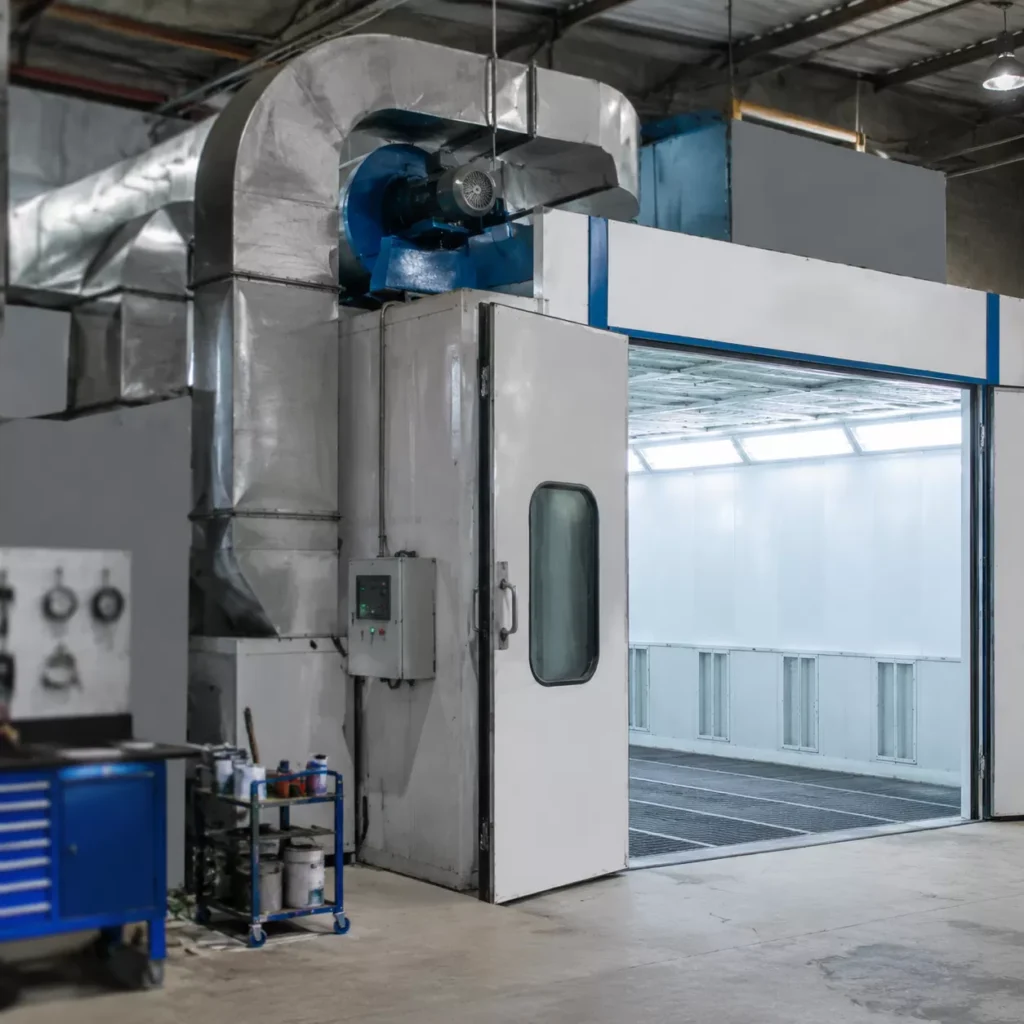
Lingering fumes, overspray settling on fresh paint, and dirt showing up in the clear coat — these are all ventilation problems. Getting the airflow right is what separates a booth that produces professional results from one that creates constant rework. This guide covers how to calculate the CFM your booth actually needs, how airflow balance works, how to troubleshoot the most common problems, and what maintenance keeps the system performing consistently.
Page URL: https://sprayboothmanufacturer.com/product/
What CFM Is and Why It Drives Everything
CFM stands for Cubic Feet per Minute — the volume of air moving through the booth every sixty seconds. Your exhaust fan’s CFM capacity directly determines how fast hazardous VOCs and paint overspray get removed from the spray zone. Too little CFM and overspray hangs in the air, solvents don’t flash off properly, and vapor concentrations can build toward unsafe levels. Getting this number right is the foundation of everything else.
The Calculation
The standard formula for determining required CFM is:
Booth Width × Booth Height × Required Air Velocity (FPM) = Required CFM
Air velocity is measured in Feet per Minute (FPM), and the required FPM depends on your booth type and what safety standard applies.
For a crossdraft booth, air moves horizontally from front to rear, so the calculation uses the interior width and height — the cross-section the air travels through. For a downdraft booth, air moves vertically from ceiling to floor, so the calculation uses the floor area (width × length) rather than the cross-section. Semi-downdraft systems are a hybrid — air enters through the ceiling at the front and exhausts at the lower rear wall, and the calculation typically uses the rear exhaust filter bank area.
The Regulatory Minimums
OSHA and NFPA 33 both set minimum airflow velocity requirements for spray operations. For most manual spray applications in a crossdraft setup, the minimum is 100 FPM. Downdraft systems generally need to maintain at least 50 FPM because the geometry of the airflow is more efficient at clearing overspray at lower velocities. These aren’t suggestions — operating below these velocities is a compliance failure and a safety issue.
For a standard 24-foot automotive booth, required CFM typically falls between 10,000 and 14,000 depending on booth dimensions and configuration. Always calculate based on your actual booth measurements rather than using a generic number.
Airflow Balance: Positive vs. Negative Pressure
Getting the right CFM is only part of the equation. The relationship between the air your exhaust fan removes and the air your make-up air unit (MAU) supplies determines whether the booth operates under positive or negative pressure — and that matters a lot for finish quality.
Positive Pressure
A slight positive pressure inside the cabin means the MAU is supplying marginally more air than the exhaust removes. The internal pressure is slightly higher than the surrounding shop, which means air wants to push outward through any gaps rather than being drawn inward. This keeps shop dust and debris from being pulled into the booth through door seals, hinges, or small gaps. A positive pressure environment is what professional finishing requires.
Negative Pressure
When the exhaust pulls out more air than the MAU replaces, the booth goes into negative pressure. The interior becomes a large vacuum — pulling unfiltered shop air in through every crack, gap, and door seal. That unfiltered air carries dust and debris that lands directly on wet paint. Contamination problems that seem to come out of nowhere are almost always a negative pressure problem. The fix is adjusting the MAU to supply slightly more air than the exhaust removes, not chasing filter or technique issues.
Monitoring Pressure
You can’t manage what you don’t measure. Manometers and Magnehelic gauges both show the pressure differential between inside and outside the booth in real time. Manometers are liquid-filled and straightforward. Magnehelic gauges give precise dial readings that are easy to read at a glance. Either works — the important thing is that you’re checking the reading regularly and acting on what it tells you.
Gauge calibration matters. If the gauge is reading incorrectly, your pressure adjustments will be wrong, and you’ll be operating outside spec without knowing it. Routine calibration keeps the measurement reliable.
Troubleshooting Common Ventilation Problems
Overspray Hanging in the Air
If paint mist hangs in the air instead of clearing quickly, the exhaust system fails to keep pace with the spraying volume. Clogged exhaust filters are the top cause, as they lower the fan’s actual working output. Swap the filters and see if the condition improves. If it does, you’ve found the problem. If the fog persists with fresh filters, recheck your CFM calculation — the fan may not be pulling enough volume for the booth size and spray method, or the fan itself may have lost capacity from wear.
Dirt and Debris in the Finish
Finding contamination in a fresh clear coat almost always indicates negative pressure. The booth is pulling dirty shop air through its gaps rather than keeping a clean internal environment. Check your MAU output against exhaust volume — the MAU needs to be supplying slightly more than the exhaust is removing. Also verify that door seals are in good condition and seated correctly. Even a good pressure balance can’t compensate for seals that aren’t making proper contact.
Dead Zones and Uneven Airflow
If overspray clears cleanly on one side of the booth but lingers in a corner, the airflow pattern has a dead zone. Unevenly loaded intake filters and off-center vehicle placement are the two most common causes. One side of the filter may become more clogged and restricted, or an off-center vehicle can block normal airflow on one side. Inspect filters for uneven dirt buildup and replace them when necessary. Position vehicles centrally inside the booth with equal clearance on both sides to ensure uniform airflow all around the perimeter.
Slow Curing and Solvent Pop
Long flash times and solvent pop both point to insufficient air movement over the painted panels. Airflow velocity is what physically removes evaporating solvents from the surface — without adequate movement, the air immediately above the panel becomes saturated and evaporation slows or stops. Verify that the booth is pulling adequate CFM and that nothing is blocking the natural air path around the vehicle. For waterborne coatings specifically, this is particularly sensitive — water requires active air movement to evaporate, not just heat.
Maintenance That Keeps Ventilation Performing
Most airflow problems trace back to basic maintenance that didn’t happen on schedule. A consistent routine protects the equipment and keeps the booth operating within spec.
Filter Replacement
Filters load up with every spray job, and as resistance increases, the fan delivers less effective CFM than it’s rated for. Exhaust and ceiling filters take the heaviest hit from overspray — depending on production volume, these typically need replacement every two to four weeks. Intake filters protect the incoming air and usually last two to four months. The reliable indicator for timing is the pressure gauge, not the calendar. When the reading drops out of the normal range, the filters are loaded regardless of when you last changed them.
Fan, Motor, and Ductwork Inspection
A monthly visual inspection of the mechanical components catches problems before they become failures. Check fan belts for wear, cracking, or slack — a slipping belt reduces exhaust capacity significantly without being obvious from a distance. Inspect the motor housing for cleanliness and signs of overheating. Look inside the accessible ductwork for overspray accumulation — heavy buildup here restricts airflow and creates a fire hazard that goes beyond just performance problems.
Pressure Gauge Calibration
The gauges are the only objective way to know whether the booth is actually in balance. If they’re reading incorrectly, every adjustment you make based on those readings will be off. Build routine calibration checks into the maintenance schedule — treat it as a critical step rather than an afterthought.
Common Questions
How often should filters be replaced? As a working baseline: exhaust filters every two to four weeks in active production environments, intake and ceiling filters every two to four months. But production volume and coating type both affect the actual rate. The Magnehelic gauge is the right tool to determine when — when static pressure drops out of the normal range, it’s time regardless of how long the filters have been in service.
What’s the right CFM for a standard automotive booth? For a 24-foot automotive booth, 10,000 to 14,000 CFM covers most configurations, but the correct number depends on your actual booth dimensions and whether you’re running crossdraft or downdraft airflow. Calculate from your specific measurements using the required FPM for your configuration — don’t use a generic estimate as a substitute.
How do I know if my booth is in negative pressure? Three reliable signs: booth doors feel unusually heavy and hard to pull open because suction is holding them shut; you feel air rushing inward when you crack a door; and you start seeing dirt or debris contamination in fresh paint jobs that doesn’t have another obvious source. If you’re seeing all three, the MAU needs to be balanced against exhaust output.
Do I actually need a Make-Up Air Unit? Yes, for any professional setup exhausting thousands of CFM. Without an MAU, you’re depending on uncontrolled shop air infiltration to replace what the exhaust removes — which means negative pressure, temperature swings, and unfiltered air entering through any available gap. An MAU gives you control over what’s coming in rather than leaving that to chance.
Tell Us What You’re Working With
Share your booth dimensions, configuration type, current airflow setup, and production volume. We’ll help you work through the CFM calculation and identify any ventilation issues in your current system — and send a detailed quote with layout recommendations usually within 48 hours.
Related Pages
- Bus Spray Booth Design Guide → https://sprayboothmanufacturer.com/transit-coach-spray-booth-requirements/
- Truck Paint Booth Guide → https://sprayboothmanufacturer.com/truck-paint-booth-semi-truck-spray-booth-specifications-buying-guide/
- Other related products → https://www.autokemanufacture.com/product
- Contact our sales Team → https://sprayboothmanufacturer.com/contact-us/
✅ CE Certified | ✅ ISO 9001:2015 | ✅ Factory Direct | ✅ Ships to 60+ Countries | ✅ 1-Year Warranty | 🔒 HTTPS Secured