
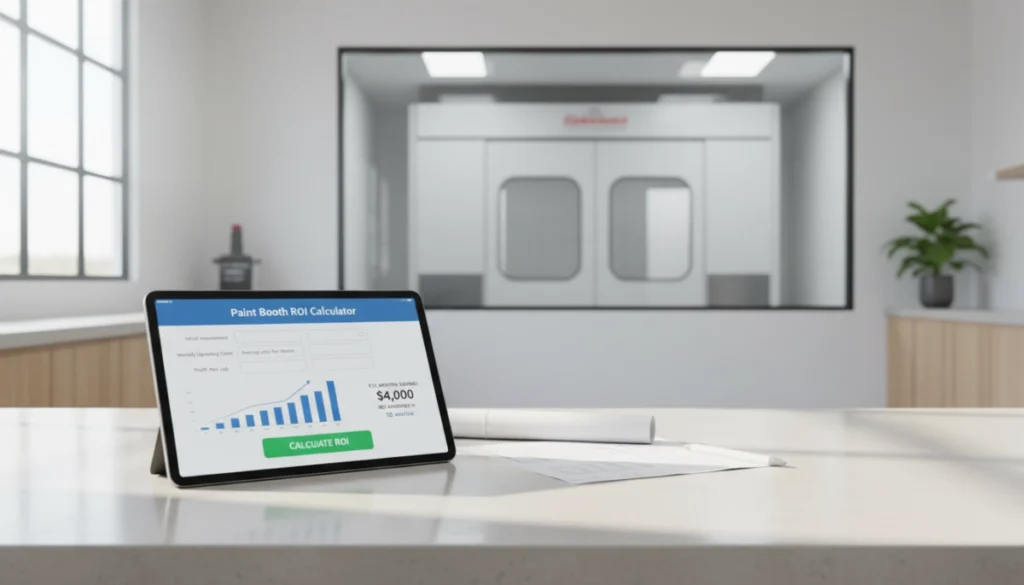
Most shop owners treat a new paint booth as a heavy upfront expense and leave it at that. The operators who consistently run profitable finishing departments think about it differently — as a production asset with a measurable return. This guide walks through how to use a paint booth ROI calculator to put real numbers behind the decision, what variables actually move the needle, and what the payback timeline looks like for different production volumes.
Page URL: https://sprayboothmanufacturer.com/product/
What ROI Actually Means for a Paint Booth
Return on investment in the coating context measures how effectively a new booth generates profit relative to its total cost — purchase price, installation, and ongoing operating expenses combined.
The core formula is straightforward:
ROI = [(Financial Gain – Cost of Investment) / Cost of Investment] × 100
If a new booth saves $50,000 in labor and energy over two years and cost $40,000 to install, the ROI is 25%. The practical goal is shortening the time it takes for financial gains to exceed the total investment — which is what the payback period measures.
Hard ROI vs. Soft ROI
It helps to separate returns into two categories.
Hard ROI is directly measurable: lower energy bills from high-efficiency motors, less material waste from better airflow, labor savings from faster flash-off and cure times, and fewer hours spent on rework.
Soft ROI is real but harder to quantify: a cleaner finishing environment that produces fewer defects, better technician retention when the workspace is professional-grade, and the referral business that comes from consistently delivering a factory-quality finish.
Both matter for the full picture. Focusing only on hard ROI undervalues the investment; ignoring hard ROI leaves you without a way to make a defensible business case.
What’s a Reasonable Payback Period?
For a professional-grade booth, 18 to 36 months is the industry benchmark. Shops running higher volume and integrating heated curing can see payback faster.
| Shop Volume | Typical Payback Period |
|---|---|
| Low — 1 to 2 cycles per day | 36–48 months |
| Medium — 3 to 5 cycles per day | 24–36 months |
| High — 6+ cycles per day | 12–24 months |
The Variables That Drive the ROI Calculation
Throughput and Cycle Time
This is the highest-impact variable in the calculation. Every minute shaved off a bake cycle is potential capacity added to the shift. If a new booth cuts 20 minutes from the average bake cycle, that can translate to one or two additional completed jobs per shift — which compounds across every working day.
More booth cycles per day means more billable revenue from the same floor space and the same labor cost. For high-volume shops, cycle time optimization is where the fastest ROI comes from.
Labor and Rework Costs
Labor is typically the largest expense in a body shop, and a significant portion of it can be non-billable — buffing out dust nibs, correcting finish defects, or respraying a job that came out wrong. A booth with proper filtration, controlled airflow, and good lighting reduces all three. Fewer defects reaching the exit stage means less correction work per vehicle and a lower effective cost per repair order.
Better lighting specifically reduces time spent on touch-up by allowing painters to see coverage accurately the first time rather than discovering missed areas after the fact.
Energy Consumption
Utility costs are a recurring drain that compounds over the life of the equipment. The biggest efficiency gains in modern booths come from two places.
Variable Frequency Drives (VFDs) on fan motors allow the system to ramp down during flash-off periods when full airflow isn’t required. Running fans at reduced speed during these phases rather than at constant maximum capacity produces meaningful electricity savings across a high-volume operation. High-efficiency burners that reach target temperatures faster and maintain them with less fuel reduce gas or propane consumption per cycle. Over a 10-year operating life, these savings typically reach tens of thousands of dollars.
Material Savings from Airflow Precision
When airflow is correctly calibrated for the booth dimensions and the spray method, more coating lands on the vehicle and less ends up in the exhaust filters. This overspray collection efficiency improvement reduces paint consumption per job. It also extends filter life — proper airflow means filters aren’t loading faster than necessary, which reduces replacement frequency and annual maintenance spend.
How to Run the Numbers Step by Step
Step 1: Establish Your Current Baseline
Before projecting returns from a new booth, you need to know what the current operation actually costs. Audit the last six months for:
- Daily throughput: how many completed paint cycles per day on average
- Monthly energy bills for gas and electricity to run the current setup
- Labor hours spent on rework, buffing, and correction across all jobs
- Filter replacement frequency and current paint waste rates
These baseline numbers are what the new booth’s performance gets measured against.
Step 2: Project the Performance Improvement
Estimate the realistic improvement in daily cycles from faster bake times. Translate that into additional revenue using your average revenue per job. Factor in the projected energy reduction from VFDs and more efficient heating. If you’re switching from a crossdraft to a downdraft configuration, factor in the labor hours saved by producing fewer defects per job.
This doesn’t need to be precise to be useful — even conservative estimates usually make a clear case.
Step 3: Account for Maintenance and Component Longevity
Compare the maintenance lifecycle of the equipment you’re evaluating against your current setup. A lower-cost booth with cheaper components typically produces higher long-term costs through more frequent fan belt failures, burner issues, and unplanned downtime. Every hour the booth is down for repairs is an hour it isn’t generating revenue — and unplanned downtime almost always hits at the worst possible time.
Step 4: Factor in the Section 179 Tax Deduction
For US-based shop owners, this is a significant piece of the financial calculation that often gets overlooked. Section 179 allows you to deduct the full purchase price of qualifying equipment from your gross income in the year it’s placed in service rather than depreciating it over several years. This front-loads the tax benefit and meaningfully lowers the effective net cost of the investment in year one. Run this through your accountant with the specific equipment cost — the impact on the real cost of the booth is often larger than people expect.
| ROI Factor | Impact |
|---|---|
| Cycle time improvement | More daily volume and billable hours |
| Section 179 deduction | Significant front-end tax savings |
| Energy efficiency | Lower monthly utility overhead |
| Airflow precision | Fewer defects, less buffing labor |
The Hidden ROI Factors Most Shops Overlook
Compliance Cost Avoidance
A booth with proper filtration and ventilation isn’t just producing a better finish — it’s avoiding OSHA and EPA penalties that can reach tens of thousands of dollars for poor air quality or inadequate ventilation. It also simplifies the local permitting process, since high-efficiency systems with documented performance specs give fire marshals and building inspectors what they need to approve the installation quickly. And proper fire suppression and airflow design typically translates to lower insurance premiums.
These aren’t dramatic line items on a monthly basis, but they represent real cost avoidance that should factor into a complete ROI calculation.
Technician Retention
Skilled painters are hard to find and expensive to replace. A shop with poor lighting, lingering fumes, and a hot or uncomfortable work environment loses technicians to competitors who offer a better environment. Replacing a lead painter costs thousands in lost production time, recruitment, and training — costs that don’t appear on the equipment invoice but are real nonetheless. A professional-grade booth environment is part of what keeps experienced people from looking elsewhere.
Finish Quality and Reputation
This is the most significant soft ROI factor and the hardest to quantify precisely. A booth that consistently eliminates dust contamination and delivers a clean, even cure produces finished vehicles that generate five-star reviews and referrals. In local markets where shop reputation drives customer choice, the ability to guarantee a factory-quality result justifies higher labor rates and builds a customer base that comes back. The margin difference between a shop known for quality and one known for being cheap is substantial over any reasonable planning horizon.
Every hour spent buffing out a problem finish is an hour of cost with no corresponding revenue. Reducing that rework rate even modestly — across the volume of jobs a busy shop handles — is a meaningful financial improvement.
Common Questions
How do I actually calculate the ROI?
Start with your baseline throughput and operating costs, then project the realistic improvement in daily cycles and the reduction in energy, labor, and material costs. Run the formula: (Net Gain from Investment – Cost of Investment) / Cost of Investment. The biggest gains typically come from cycle time improvement and rework reduction — both of which have direct labor cost implications.
What’s a realistic payback timeline?
For most professional shops in the US, a quality booth pays back within 12 to 36 months depending on daily volume. High-volume shops running six or more cycles per day and transitioning from an older crossdraft system to an efficient downdraft with heated curing tend to hit payback at the shorter end of that range. Lower-volume operations should plan for 36 months or more.
How much does energy efficiency actually affect long-term ROI?
Significantly. A booth with VFD motors and LED lighting typically cuts utility costs by 30% to 50% compared to older constant-speed systems. Over a 10-year operating life, those savings at a busy production shop add up to tens of thousands of dollars — real money that would otherwise appear on the monthly utility bill indefinitely.
Does better airflow actually reduce paint costs?
Yes. When airflow is calibrated correctly, transfer efficiency improves — more paint reaches the vehicle surface and less gets pulled into the exhaust filters as waste. For high-volume shops, even a 5% to 10% reduction in paint waste represents a meaningful annual saving on material cost.
Can Section 179 be applied to a paint booth purchase?
In most cases, yes. Consult your accountant with the specific equipment purchase price and the year it will be placed in service — the immediate deduction against gross income can significantly reduce the effective net cost of the booth in the year of purchase, which changes the payback period calculation materially.
Tell Us What You’re Working With
Share your current daily cycle count, energy costs, average revenue per job, and the type of coating work you’re running. We’ll help you build a realistic ROI projection for your operation and send a detailed equipment quote with layout drawings — usually within 48 hours.
Related Pages
- Bus Spray Booth Design Guide → https://sprayboothmanufacturer.com/transit-coach-spray-booth-requirements/
- Truck Paint Booth Guide → https://sprayboothmanufacturer.com/truck-paint-booth-semi-truck-spray-booth-specifications-buying-guide/
- Other related products → https://www.autokemanufacture.com/product
- Contact our sales Team → https://sprayboothmanufacturer.com/contact-us/
✅ CE Certified | ✅ ISO 9001:2015 | ✅ Factory Direct | ✅ Ships to 60+ Countries | ✅ 1-Year Warranty | 🔒 HTTPS Secured