
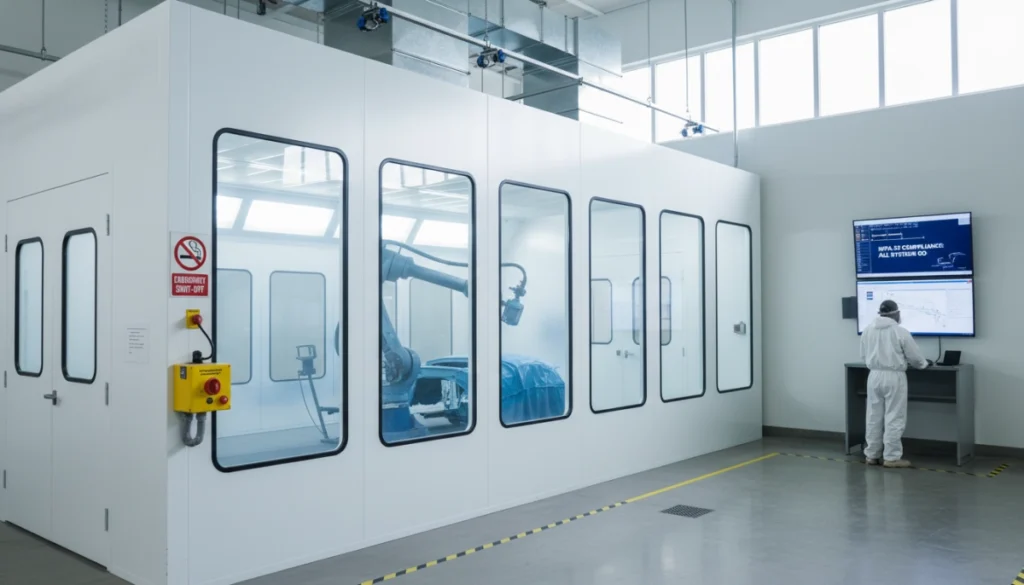
Running a paint booth without understanding NFPA 33 is one of the more common ways shops end up with failed inspections, denied insurance claims, or something worse. The standard exists because spray finishing with flammable materials is genuinely dangerous, and the rules around booth construction, ventilation, electrical equipment, and fire suppression reflect what it actually takes to keep a spray environment from becoming a fire. This guide covers the key requirements across each area so you know what you’re working with — and what inspectors will be looking for.
Page URL: https://sprayboothmanufacturer.com/product/
What NFPA 33 Covers and Who Enforces It
NFPA 33 is the national standard for spray applications using flammable or combustible materials. It defines what a “spray area” is, sets the design and operational requirements that apply within that area, and provides the technical foundation that OSHA’s 1910.107 regulation references for workplace safety enforcement.
The spray area under NFPA 33 isn’t just the inside of the booth. It includes the exhaust ductwork where residues accumulate, and any area outside the booth where dangerous concentrations of vapor, mist, or overspray are present due to the spraying process. This matters because it determines where specialized electrical equipment is required and where fire suppression systems need to reach.
Three parties enforce compliance in practice. The Authority Having Jurisdiction (AHJ) — typically your local fire marshal or building inspector — reviews plans and conducts on-site inspections. OSHA enforces 1910.107, which references NFPA 33 directly, and focuses on worker safety. Insurance providers increasingly require documented compliance with NFPA standards before issuing or renewing coverage on facilities with spray booths. A booth that fails on any of these fronts can mean an immediate shutdown, a denied claim, or both.
The coatings themselves matter too. NFPA 33 distinguishes between flammable liquids (flash point below 100°F) like lacquers, solvent primers, and thinners, and combustible liquids (flash point at or above 100°F) like high-solids coatings. Once any of these materials is atomized into a mist, they create a hazardous atmosphere that falls under the standard regardless of their classification.
Construction and Structural Requirements
Materials
The booth structure must be non-combustible throughout. Steel at a minimum of 18-gauge is the standard material for most professional installations. Reinforced concrete works for permanent industrial setups where it’s practical. Masonry offers the highest fire rating for integrated spray rooms. Whatever the material, it needs to be capable of containing vapors and resisting fire rather than contributing to it.
Separation Distances
NFPA 33 requires a minimum of 3 feet of clear space on all sides and above the booth. This isn’t storage space, temporary staging area, or overflow — it needs to stay clear. The purpose is threefold: maintenance access for filters and motors, fire department access around the perimeter, and a fire break that prevents an internal booth fire from spreading to the rest of the facility. If the booth is positioned near property lines, additional separation from neighboring structures is required.
Exit doors and fire equipment must remain unobstructed. Positioning the booth in a way that blocks emergency access is a compliance failure that fire marshals look for specifically.
Interior Surfaces
The inside of the booth needs smooth, non-porous surfaces that don’t trap overspray. Rough interior surfaces accumulate paint residue over time, which increases the fuel load inside the booth. Flush-bolt panel construction and coated steel interiors keep residue on the surface rather than absorbed into it, which makes cleaning more effective and reduces fire risk from built-up contamination.
Ventilation: The Most Critical Safety System
Ventilation is what keeps flammable vapor concentrations from reaching dangerous levels in the spray area. It’s not just about air quality for the painter — it’s about making sure the atmosphere inside the booth never approaches the concentration where a spark becomes an explosion.
Airflow Velocity
The minimum standard for crossdraft and downdraft booths under NFPA 33 is 100 linear feet per minute (LFM) of airflow velocity. This rate is the benchmark for moving overspray immediately to the exhaust filters and keeping solvent vapor below 25% of the Lower Flammable Limit (LFL). Falling below this velocity puts the booth out of compliance and into a potentially hazardous condition.
Exhaust Ductwork
Exhaust routing needs to follow a direct path with as few bends as possible. Dead spots in ductwork are where residue accumulates and where vapor can pool rather than being carried out. The exhaust stack needs to terminate at least 6 feet away from any air intake and at least 6 feet above the roofline. All ductwork must be heavy-gauge steel with liquid-tight joints to prevent leaks inside the facility.
Recirculation
Recirculating exhaust air to reduce heating costs is possible under NFPA 33 but requires a high standard of gas detection equipment and automated bypass dampers. For most standard shop operations, a 100% fresh air intake and full exhaust setup is the reliable path to compliance. It’s simpler, easier to maintain, and eliminates the monitoring complexity that recirculation introduces.
Interlocking Systems
The interlock between the exhaust fans and the spray equipment is a hard requirement under both NFPA 33 and OSHA 1910.107. The logic is straightforward: if the exhaust fan isn’t running at the required CFM, the spray gun won’t receive compressed air or power. This prevents a painter from spraying in a booth where the ventilation has failed and vapors are accumulating. It’s not an optional feature — it’s a required safety mechanism.
Electrical Classification
The interior of a spray booth is a hazardous location, and the electrical equipment installed there has to be rated for it. Mixing atomized flammable liquids with air creates an atmosphere where a standard electrical spark is an ignition source.
Hazardous Zone Classification
| Zone Location | Classification | Requirement |
|---|---|---|
| Inside the booth and exhaust ducts | Class I, Division 1 | All equipment must be explosion-proof, rated for continuous vapor exposure |
| Within 3 feet of any door or opening | Class I, Division 2 | Equipment must be vapor-tight or sealed against spark contact |
| Beyond the 3-foot boundary | Non-hazardous | Standard industrial wiring generally acceptable |
Every piece of electrical equipment inside the spray zone — lights, motors, switches, sensors — needs to be rated for Class I, Division 1 conditions. This is where many shops get tripped up, particularly with lighting. Standard shop lights are not compliant inside a spray booth regardless of how convenient they are to install.
Explosion-Proof Lighting
You must fit all fixtures inside the spray area with glass shields and gaskets to block vapors from reaching the light source. You should wire these fixtures to switch on only while the ventilation system operates. This simple interlock stops anyone from working inside the booth without active exhaust ventilation.
Grounding and Bonding
Static electricity builds up as paint moves through a spray gun and hose. Without a path to discharge that static safely, the charge can jump to a nearby surface — and in a vapor-rich environment, that spark is all it takes. You must ground every part you paint. You also need to electrically bond all metal booth components—walls, exhaust stack, pump, and control panel—to eliminate potential voltage differences that could create sparks. Painters should use conductive footwear or grounding straps. This is one of the most overlooked compliance areas and one of the most frequently flagged during inspections.
Fire Suppression Requirements
Automatic Suppression Systems
NFPA 33 requires an automatic fire suppression system in every spray booth. The type depends on the specific coating process and chemicals involved.
Dry chemical systems are the industry standard for most paint booth applications. These systems quickly suppress flames by disrupting the fire’s chemical reaction and work reliably with most coatings used in automotive and industrial finishing. You can use CO₂ systems for special applications where you want to reduce post-discharge cleanup and avoid equipment damage. You may integrate water sprinkler systems into the building’s existing wet-pipe network whenever they meet the density requirements for hazardous areas.
Manual Extinguishers
Automatic fire suppression serves as the main line of defense, while manual backup systems also remain mandatory. You must place portable fire extinguishers rated for Class B flammable liquid fires and Class C electrical fires within 30 feet of the spray area, and mount them in clearly marked, easily accessible spots. Hiding an extinguisher behind equipment or tucked away in a hard-to-reach corner renders it useless when needed.
System Integration
The suppression system doesn’t operate in isolation. When it activates, it needs to trigger the building’s main fire alarm automatically to alert all personnel. It also needs to cut power to spray equipment and compressed air lines immediately. In most configurations, the exhaust fans also shut down on suppression activation — preventing the ventilation from feeding oxygen to the fire or drawing flames further into the ductwork.
Daily Operations and Housekeeping
Compliance isn’t just about how the booth is built — it’s about how it’s run. A booth that’s built correctly but maintained poorly will eventually fail an inspection or cause an incident.
Waste Material Handling
Rags soaked with flammable coatings or solvents are a spontaneous combustion risk. You must place every soaked rag into a UL-listed metal container with a self-closing lid, and empty these containers every day. You also need to remove and discard saturated overspray filters in compliance with local environmental regulations. Leaving loaded filters inside the booth overnight creates an avoidable yet easily overlooked fire hazard.
Regular scraping and cleaning of booth walls and floors prevents combustible residue from accumulating to levels that meaningfully increase fire risk. This is a daily task, not a weekly one.
Flammable Liquid Storage
NFPA 33 limits how much flammable or combustible liquid can be present in the spray area at any time. The practical rule is to keep only enough for one shift or one day inside the spray area. Any quantity beyond the immediate need goes into an approved flammable liquid storage cabinet or a dedicated, ventilated mix room. All containers stay tightly closed when not actively in use.
Documentation
Maintenance logs satisfy inspectors and insurance auditors because they demonstrate ongoing compliance rather than just a snapshot at inspection time.
| Task | Frequency |
|---|---|
| Filter inspection for loading and airflow resistance | Daily |
| Manometer readings per shift | Every shift |
| Fan and motor inspection for belt wear, vibration | Monthly |
| Fire suppression system professional testing | Semi-annually |
| Full electrical and grounding audit | Annually |
If something isn’t documented, an auditor has no way to verify it was done. Consistent recordkeeping protects the business and keeps warranty coverage intact.
The Most Common Compliance Mistakes
Non-certified or homemade booths. A booth that isn’t engineered and certified to NFPA standards almost certainly lacks fire-rated construction and proper airflow. If a fire starts in a non-compliant booth, the insurance provider has grounds to deny the claim. OSHA can issue citations that are expensive and difficult to fight. The cost of a pre-engineered certified booth is predictable; the cost of a non-compliant incident is not.
Cluttered perimeter. The 3-foot clear zone around the booth tends to accumulate paint cans, parts racks, and miscellaneous equipment over time. Fire marshals look for this specifically. Marking the zone with floor tape makes it easier to enforce and visible to any inspector walking the floor.
Inadequate grounding and bonding. Static ignition is a real mechanism for fires in spray environments, and it’s one that’s easy to prevent with proper grounding equipment and consistent use. Workpieces not grounded, painters working without grounding straps, bonding connections that have worked loose from vibration — these are all common findings during compliance inspections.
| Common Pitfall | Consequence | Fix |
|---|---|---|
| Uncertified booth | Fire risk, fines, insurance denial | Use a pre-engineered certified booth |
| Cluttered 3-foot zone | Blocked exits, fire spread risk | Mark and enforce the clear zone |
| Poor grounding | Static ignition risk | Ground all parts, bond all metal components |
Common Questions
How often should I inspect the spray booth? Daily filter checks and ventilation verification are the baseline. Weekly interior cleaning for residue buildup. Semi-annual professional testing of the fire suppression system and interlocks. Annual electrical and grounding audit. The more thorough your routine, the less likely you are to have a surprise finding during an AHJ inspection.
What’s the difference between NFPA 33 and OSHA 1910.107? They work together but are different in nature. OSHA 1910.107 is federal law with enforcement power — violations result in fines. NFPA 33 is the technical standard that defines how the design and construction requirements are met. In most jurisdictions, meeting NFPA 33 puts you in compliance with OSHA’s requirements as well, since 1910.107 heavily references the NFPA standard.
Can I convert an existing room into a compliant spray booth? Technically yes, but it’s rarely cost-effective. A standard room typically lacks fire-rated wall construction, hazardous location electrical equipment, and a dedicated intake and exhaust system capable of maintaining 100 LFM. To meet NFPA 33, the converted room needs non-combustible walls, explosion-proof lighting and motors, and an integrated automatic suppression system. Most shop owners find that a pre-engineered certified booth is faster and cheaper than retrofitting an existing structure to meet these requirements.
Do waterborne paints still fall under NFPA 33? Yes. Even though waterborne coatings have lower VOC content than solvent-based systems, the standard applies to combustible liquids as well as flammable ones. When any coating is atomized into a mist during application, it creates a hazardous atmosphere that NFPA 33 governs regardless of the base chemistry.
Tell Us What You’re Working With
Share your facility details, booth type, current compliance status, and any specific inspection requirements you’re working toward. We’ll help you identify what’s needed and send a detailed quote with layout and compliance documentation — usually within 48 hours.
Related Pages
- Bus Spray Booth Design Guide → https://sprayboothmanufacturer.com/transit-coach-spray-booth-requirements/
- Truck Paint Booth Guide → https://sprayboothmanufacturer.com/truck-paint-booth-semi-truck-spray-booth-specifications-buying-guide/
- Other related products → https://www.autokemanufacture.com/product
- Contact our sales Team → https://sprayboothmanufacturer.com/contact-us/
✅ CE Certified | ✅ ISO 9001:2015 | ✅ Factory Direct | ✅ Ships to 60+ Countries | ✅ 1-Year Warranty | 🔒 HTTPS Secured