
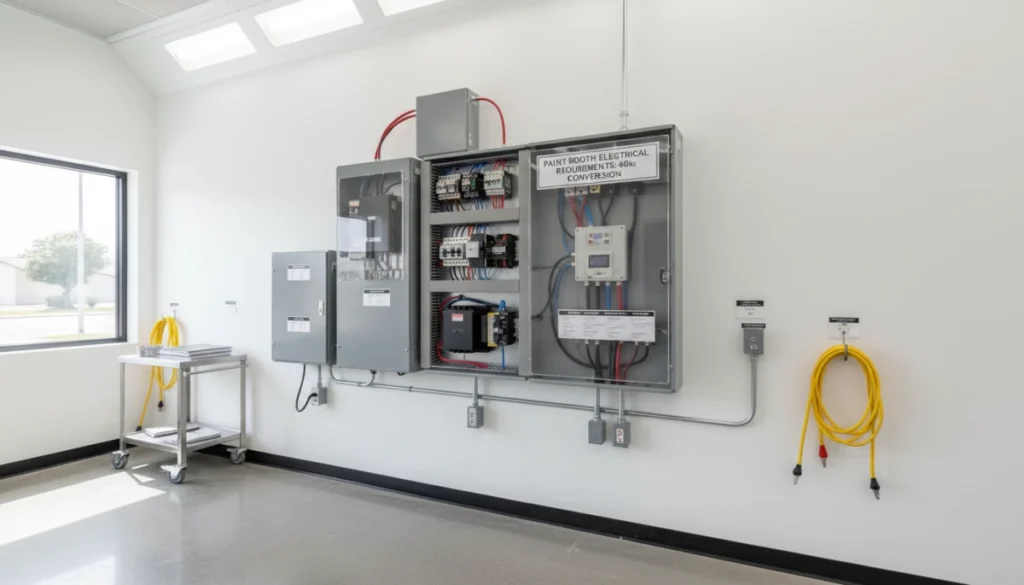
Importing a high-performance industrial spray booth from Europe or Asia is a practical option for many North American shops. The problem is that most of these booths are built for a 50Hz electrical supply, and the US standard is 60Hz. That 10Hz gap isn’t a minor inconvenience — it fundamentally changes how every motor in the booth behaves, and running 50Hz equipment on a 60Hz grid without proper conversion leads to motor burnout, compromised airflow, and code violations. This guide covers what the conversion actually involves, what hardware you need, and how to stay compliant with US safety standards.
Page URL: https://sprayboothmanufacturer.com/product/
Why 50Hz and 60Hz Are Not Interchangeable
What Frequency Does to a Motor
The frequency of the electrical supply controls how fast AC motors spin. The relationship is direct: motor speed in RPM equals 120 times the supply frequency divided by the number of motor poles. A motor built to run at 3,000 RPM on a 50Hz supply will attempt to run at 3,600 RPM when connected to a 60Hz grid. That’s a 20% speed increase the motor was never designed or balanced for.
The mechanical consequences are immediate. Bearings, drive belts, and fan impellers engineered and balanced for one fixed speed now operate under 20% higher load. The fans deliver much greater airflow volume. Power demand rises well beyond 20% — since fan power follows the cube of speed, the motor works far harder than its rated design allows.
The thermal consequences follow. When a motor’s inductive reactance changes with frequency, the current draw increases. Without proper protection, this excess current builds up as heat in the motor windings. Left unaddressed, it degrades the insulation and eventually causes a complete motor failure.
The Voltage-to-Frequency Relationship
Successful 60Hz conversion requires understanding the relationship between voltage and frequency. To maintain consistent torque and stop the motor’s magnetic core from saturating or weakening, you must adjust voltage proportionally as frequency changes. Raise frequency by 20%, and increase voltage by the same ratio. A Variable Frequency Drive (VFD) operates on this core principle: it keeps the proper voltage-to-frequency ratio and delivers the designed electrical profile to the motor.
| Component | 50Hz Operation | 60Hz (Unadjusted) | Risk |
|---|---|---|---|
| Motor Speed | 3,000 RPM | 3,600 RPM | Excessive vibration, bearing wear |
| Airflow Volume | Baseline CFM | ~120% of baseline | Turbulence in spray zone |
| Power Draw | Rated amps | ~170% of rated amps | Thermal overload, motor burnout |
| Static Pressure | Baseline | ~144% of baseline | Ductwork and housing stress |
How 60Hz Affects Paint Booth Performance
Ventilation and Airflow
The most immediate impact shows up in the fans. A 20% RPM increase means the fans move significantly more air than the booth was designed to handle. That sounds like it might be useful — more airflow seems better — but in practice it creates problems. The static pressure inside the cabin rises sharply, disrupting the pressure balance that quality finishing depends on. And the horsepower required by the fan increases dramatically because of the cubic relationship between speed and power demand, which means the motor is now working far above its rated capacity.
The result is either a booth that constantly trips thermal protection breakers, or one where the motor quietly overheats over time until it fails.
Filtration
Faster fans push air through intake and exhaust filters at a higher velocity than the filters’ rated capacity. Elevated airspeed keeps the filter media from handling particle loads effectively. Overspray penetrates deeper into the filter fibers, clogs form more quickly, and in extreme cases, high-pressure air completely bypasses the filter seals and carries unfiltered air into the spray zone. Filter life shortens and replacement costs increase.
Heating System
The burner’s combustion blower motor is subject to the same 20% speed increase as the exhaust fans. If the combustion blower spins faster, it forces more air through the burner than the flame calibration allows, throwing off the air-to-fuel ratio and making it too lean. The result is an inefficient or unstable flame — the burner may lock out, run inconsistently, or stress the heat exchanger over time through irregular thermal cycling.
Pneumatic Controls and Solenoids
Solenoid valves and pneumatic control components designed for 50Hz can run hot, chatter, or fail to engage properly on 60Hz power. Built-in flash-off fans connected directly to 60Hz power without adjustment create uneven airflow across panels, which can cause premature skinning of water-based coatings before the paint has properly flashed.
The Hardware Required for a Proper Conversion
Variable Frequency Drives (VFDs)
A VFD is the most effective single piece of equipment for managing the conversion. Rather than letting a 50Hz motor run uncontrolled at 20% above its design speed, the VFD takes the 60Hz supply and outputs the precise frequency and voltage the motor needs to run at its intended RPM. This protects the motor, keeps airflow velocity correct, and lets users adjust fan speed to match the booth’s actual requirements instead of locking it to the grid’s fixed output.
Anyone converting a booth for long-term professional use needs to install VFDs on the primary exhaust and intake fan motors.
Transformers
Most imported booths are designed for 380V to 400V at 50Hz. North American shops typically supply 208V, 240V, or 480V three-phase power. High-quality industrial transformers bridge this gap, matching the voltage to what the booth’s internal components need. Isolation transformers also provide a layer of protection between the utility grid and the booth’s sensitive electronics.
Motor Replacement
In some cases, modifying the existing motor isn’t worth the risk. If a motor doesn’t have an adequate service factor to handle the increased heat load from the frequency shift, replacement with a NEMA-rated motor is the more reliable path. In the spray zone, any replacement motor must also be explosion-proof rated for Class I, Division 1 or Division 2 hazardous locations. The upfront cost of a motor swap is typically less than dealing with the downtime from a mid-production failure.
Control Circuit Transformers
The PLCs, timers, and relays in the booth control panel are sensitive to voltage variations. A dedicated control circuit transformer steps the primary power down to 110V or 24V as needed for the control logic, isolating it from the frequency-related voltage fluctuations on the primary supply. This protects the control panel components and keeps the booth operating predictably.
Thermal Overload Protection
When frequency changes, current draw changes. The original thermal overload settings calibrated for 50Hz operation are wrong for 60Hz. Updating the overload heaters and breakers to match the new actual current draw is non-negotiable. Old settings that are too high provide no real protection. Settings that are calibrated too conservatively for the new draw will trip constantly. Both are problems — and both are preventable by recalculating Full Load Amps for 60Hz and installing protection devices sized to match.
Regulatory Compliance: What US Codes Require
NFPA 33 and NEC Article 516
The interior of a spray booth is classified as a Class I, Division 1 hazardous location because flammable vapor concentrations can reach ignitable levels during normal operation. Two primary codes govern the electrical requirements in this environment.
NFPA 33 sets the standards for spray finishing operations using flammable materials, including airflow velocity requirements, interlock systems, and fire safety provisions. NEC Article 516 specifies the wiring methods required for hazardous spray areas — every conduit, junction box, and wire run inside the spray zone must meet these requirements. A 60Hz conversion that rewires the unit, adds components, or replaces motors must meet these standards no matter how manufacturers built the original equipment.
OSHA requires that electrical equipment in hazardous locations be listed by a recognized testing laboratory. Equipment carrying only a CE mark — the European conformity marking — does not satisfy this requirement for US inspectors.
UL/CSA Listing and Field Evaluations
This is where many imported booth conversions run into trouble. Most equipment from 50Hz markets comes with CE certification, which has no legal standing with North American building inspectors, fire marshals, or insurance underwriters. Any modification to a motor or control panel typically voids the original factory certification.
If the converted equipment doesn’t carry a UL or CSA listing, the path to compliance is a field evaluation — a third-party engineer inspects the converted system on-site and provides a certification specific to that installation. Without this, an insurance provider can legitimately deny a claim in the event of a fire. Field evaluations cost money, but operators must complete this step when converting equipment that manufacturers did not originally build to North American standards.
Explosion-Proof Integrity
Any new motor installed inside the spray zone must be specifically rated for hazardous locations. Conduit runs need properly poured seals to prevent flammable vapors from traveling through the conduit to the control panel. Sensor and switch circuits need to be intrinsically safe — meaning they can’t generate enough energy to ignite the booth atmosphere even under fault conditions. These requirements don’t change during a conversion; if anything, the conversion is an opportunity to verify that the original installation met them.
Step-by-Step Conversion Process
Step 1 — Audit the motor nameplates. Document the voltage, current, frequency, and RPM ratings on every motor in the booth. Most imported equipment is rated for 380V to 400V at 50Hz. Determine whether each motor is inverter-duty or dual-rated. If it isn’t, plan for a VFD installation or motor replacement.
Step 2 — Assess the fan curves. With a 20% RPM increase, verify whether each motor can handle the increased power demand. Check the torque characteristics, verify the fan assembly balance for higher speed, and calculate the new CFM output to keep it within the booth’s design limits.
Step 3 — Rewire the control panel. Most 50Hz booths use 220V for control logic; US practice is 110V. Install control circuit transformers to step down the line voltage for the PLC, relays, and timers. Update any components that aren’t rated for 60Hz operation.
Step 4 — Install and calibrate thermal overload protection. Recalculate Full Load Amps for 60Hz operation and replace all overload heaters and breakers with devices sized for the new current draw.
Step 5 — Perform airflow balancing. After the electrical work is complete, measure static pressure and airflow velocity inside the cabin. Adjust intake and exhaust dampers as needed. Verify that filter velocity stays within the filters’ rated capacity. If VFDs were installed, calibrate ramp-up speeds to protect belts and bearings during startup.
Step 6 — Document everything. Update the electrical schematics inside the control panel to reflect the converted configuration. Maintenance personnel need accurate drawings — leaving outdated 50Hz schematics in a converted booth creates real safety and troubleshooting problems.
Common Mistakes That Cause Failures
Ignoring the motor service factor. The service factor is the motor’s built-in safety margin. A motor with a service factor of 1.0 has no margin — it’s rated for exactly its nameplate load and nothing more. Running that motor 20% above design speed on 60Hz eliminates the margin entirely and guarantees thermal failure under load. Always check the nameplate SF and upgrade to a NEMA-rated motor with adequate margin if the original doesn’t have it.
Not checking for vibration at the new speed. A fan assembly balanced for 1,450 RPM may hit a resonance frequency at 1,750 RPM. The vibration at resonance destroys bearings, loosens mounting hardware, and can crack fan housings over time. Post-conversion vibration analysis is a required check, not an optional one.
Leaving outdated thermal overload settings. The original overload settings are calibrated for 50Hz current draw. At 60Hz, these settings are wrong. Leaving them in place either means the protection trips constantly at normal operating conditions, or — worse — it provides no real protection during a genuine overcurrent event.
Failing to update the electrical documentation. A conversion that adds VFDs, transformers, or replaces motors without updating the cabinet schematics creates a documentation mismatch that makes troubleshooting difficult and potentially dangerous. Every component change needs to be reflected in updated drawings.
Common Questions
Can I run a 50Hz motor on 60Hz without a VFD? The motor will operate, but it runs 20% above its designed speed, draws far more current, and produces excess heat. Without correcting the voltage-to-frequency ratio, the motor insulation will degrade and eventually fail. You can sometimes compensate with mechanical adjustments to the pulley ratio, but a VFD is the more reliable and controllable solution.
What happens to airflow if I don’t adjust the fan speed? Without adjustment, fan output increases substantially — both in volume and in static pressure. While more airflow sounds beneficial, the pressure spike upsets the cabin balance you need for a quality finish, and higher air velocity through the filters pulls overspray through the filter media faster than the filters can handle by design. Breakers trip from the increased power demand, or the motor overheats. Neither outcome is acceptable in a production environment.
Is a basic 60Hz conversion NEC compliant? Not automatically. Simply connecting 50Hz equipment to a US supply without proper conversion hardware, hazardous location wiring methods, and UL or CSA listed control panels doesn’t meet NEC Article 516 or NFPA 33 requirements. In most jurisdictions, a field evaluation by a third-party testing lab is required to certify the converted installation.
What does a full conversion typically cost? The cost depends on how much work is needed. VFD installation for fan motor control typically runs $1,500 to $3,500. Motor replacement with NEMA-rated explosion-proof motors runs $2,000 to $5,000 per motor. A full control panel overhaul for total compliance typically starts at $7,000 and up. The right approach depends on the specific booth, its original construction, and what the local jurisdiction requires for certification.
Will the conversion void the equipment warranty? Almost always yes. Most manufacturers will not honor a warranty if operators run the equipment on a power supply that does not match the nameplate specification. Users recognize this as an inherent cost when importing 50Hz equipment for North American operation and should factor it into total acquisition cost evaluations.
Tell Us What You’re Working With
Share your booth model, existing electrical supply details, and facility location. We’ll spec out the right conversion approach for your operation and send a detailed technical recommendation with cost estimates — usually within 48 hours.
Related Pages
- Bus Spray Booth Design Guide → https://sprayboothmanufacturer.com/transit-coach-spray-booth-requirements/
- Truck Paint Booth Guide → https://sprayboothmanufacturer.com/truck-paint-booth-semi-truck-spray-booth-specifications-buying-guide/
- Other related products → https://www.autokemanufacture.com/product
- Contact our sales Team → https://sprayboothmanufacturer.com/contact-us/
✅ CE Certified | ✅ ISO 9001:2015 | ✅ Factory Direct | ✅ Ships to 60+ Countries | ✅ 1-Year Warranty | 🔒 HTTPS Secured