
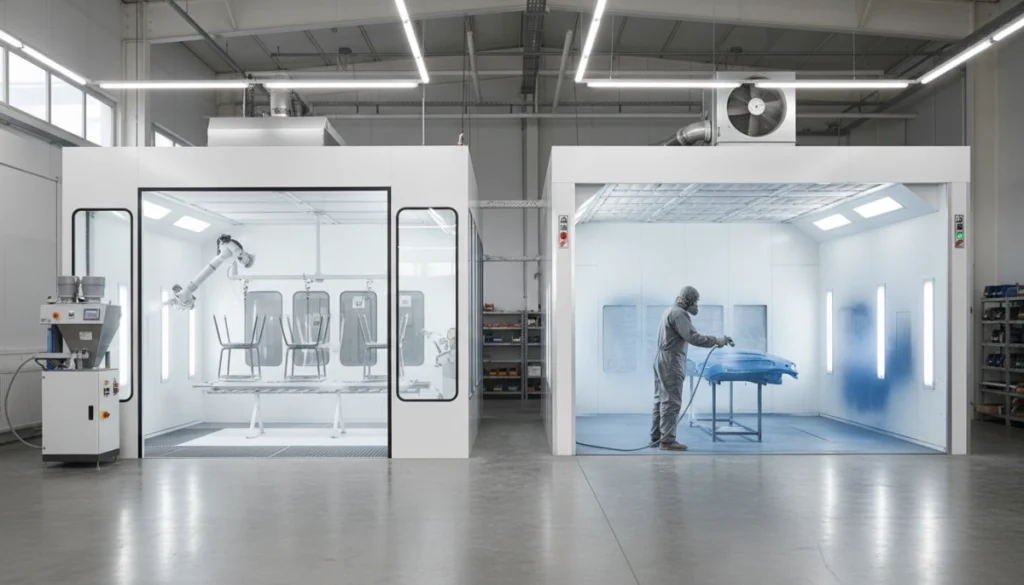
Choosing between a powder coating booth and a liquid paint booth isn’t just a question of what looks better — it’s a decision about your entire production workflow, compliance requirements, and long-term operating costs. The two systems handle coating application, airflow, filtration, and waste management in fundamentally different ways. This guide breaks down the core differences so you can make the right call for your specific operation.
Page URL: https://sprayboothmanufacturer.com/product/
How the Two Systems Actually Work
Application Method
The difference starts at the gun. Powder coating applies electrostatic spray deposition. You charge powder particles and ground the part, creating an attractive force that pulls powder onto surfaces and coats edges and complex shapes evenly.It’s a forgiving process because the physics are working in your favor.
Liquid paint adopts pneumatic atomization: compressed air breaks liquid coating into fine mist and sprays it onto surfaces. Operators follow a line-of-sight process, and paint cannot reach surfaces without direct spray gun aiming.Getting consistent coverage on complex shapes requires technique that takes time to develop.
Airflow Strategy
The airflow design of each system reflects what it’s actually trying to manage.
In a powder coating booth, the goal is containment. There are no solvent fumes to clear, so the system doesn’t need high-velocity exhaust. Instead, airflow is designed to keep powder dust inside the enclosure so the overspray recovery system can collect and reclaim it.
In a liquid paint booth, the goal is VOC management. Whether the booth runs crossdraft or downdraft airflow, it needs to move enough air to keep solvent vapor concentrations below explosive limits and pull overspray away from the fresh coating before it causes contamination problems.
Filtration
Powder booths use dry cartridge filters designed for material recovery. Overspray powder falls into a collection hopper and can be reclaimed and reused. With a pulse-cleaning system on the cartridges, filters can last a year or more before needing replacement.
Liquid paint booths use multi-stage fiberglass or polyester arrestors that capture wet overspray. Once paint hits the arrestor, it becomes solid hazardous waste that needs to be disposed of — nothing is reclaimed. Filter changes every 50 to 100 hours of spray time are typical for maintaining proper airflow.
| Feature | Powder Coating Booth | Liquid Paint Booth |
|---|---|---|
| Primary Filter Type | Dry cartridge — recyclable | Multi-stage arrestors — disposable |
| Recovery Potential | High — overspray is reusable | Zero — captured as waste |
| Exhaust Goal | Dust containment | Solvent vapor evacuation |
| Filter Lifespan | Long — 1 year+ with pulse cleaning | Short — every 50–100 spray hours |
Performance and Finish Quality
Where Powder Wins: Durability
If you’re finishing industrial equipment, off-road parts, outdoor furniture, or anything that takes physical punishment or weather exposure, powder coating produces a tougher result than liquid paint. The thermoset polymer resins used in powder coating chemically bond during the bake cycle, creating a film that resists chipping, cracking, and impact significantly better than a liquid finish. It also handles UV exposure and moisture better, which is why it’s the standard for infrastructure and outdoor applications.
The natural film thickness of powder — typically 2 to 6 mils — contributes to this durability, though it also means powder isn’t ideal for precision parts with tight tolerances or fine details that can get buried under a thick coating layer.
Where Liquid Paint Wins: Appearance and Flexibility
For automotive finishing, luxury goods, custom colors, and any application where the visual result is the priority, liquid paint gives you more control. You can mix custom colors and metallics on-site, achieve a mirror-like gloss depth that powder can’t replicate, and execute specialty effects — candies, pearls, fades — that powder simply can’t do.
Liquid paint also applies much thinner than powder — as thin as 0.5 to 1 mil — which matters for parts with fine engravings, tight fits, or complex geometry where coating thickness has functional consequences.
| Feature | Powder Coating Finish | Liquid Paint Finish |
|---|---|---|
| Durability | Exceptional — chip and scratch resistant | Moderate — more prone to chipping |
| Texture | Thicker, slight orange peel possible | Smooth, glass-like |
| Color Precision | Stock colors — difficult to custom mix | Infinite custom options |
| Typical Mil Depth | 2.0–6.0 mils | 0.5–1.5 mils |
Environmental Compliance and Waste
VOC Regulations
Powder coating is essentially solvent-free, which means it bypasses the most demanding VOC emission requirements. If your operation runs liquid paint, you’re dealing with air quality permits, emission monitoring, and potentially carbon filtration or thermal oxidizer equipment to stay legal depending on your volume and location. As regulations have continued tightening, the compliance overhead for liquid paint operations has increased, while powder operations remain straightforward from a VOC standpoint.
Waste Management
This is one of the most practical economic differences between the two systems. In a powder setup with proper overspray recovery, the reclaim rate can reach 95% to 98% — material that doesn’t hit the part goes back into the system rather than into a waste bin. The waste management story for powder is genuinely simple.
Liquid paint waste is hazardous sludge. The overspray captured in booth filters and pits requires documented disposal with a licensed hazardous waste hauler. The cost isn’t just the hauling fee — it’s the record-keeping and compliance documentation that comes with it. For high-volume liquid paint operations, this is a real and recurring overhead expense.
Safety Requirements
Both systems require careful safety management, but the specific risks are different.
In a liquid paint booth, the primary hazard is flammable solvent vapor. The booth needs to maintain high-volume airflow to keep vapor concentrations below explosive limits, and all electrical components inside the spray zone must be explosion-proof rated.
In a powder coating booth, the risk is combustible dust. Powder suspended in air at high concentration can ignite. Proper grounding of the equipment and parts prevents static discharge, and the containment airflow system keeps dust concentration manageable. Fire suppression systems are required in both cases.
Economic Comparison: Upfront Cost vs. Operating Cost
Initial Investment
Liquid paint booths have a lower entry cost for the booth itself, though high-end downdraft configurations can narrow that gap. Powder coating setups require a higher upfront investment because you’re buying not just a booth but a dedicated curing oven and electrostatic application equipment.
Material Efficiency
This is where powder coating makes its economic case most clearly. Transfer efficiency in a liquid paint booth typically runs 30% to 65% — meaning a significant portion of your coating material ends up in the filters as waste. In a powder setup with overspray recovery, transfer efficiency can reach 98%. For high-volume operations, the difference in material cost over a year is substantial.
| Feature | Powder Coating | Liquid Paint |
|---|---|---|
| Transfer Efficiency | Up to 98% with recovery | 30–65% average |
| Waste Disposal | Minimal — recyclable | High — hazardous sludge |
| Material Cost Per Part | Lower | Higher due to waste and solvents |
| Initial CapEx | Higher | Lower to moderate |
Energy and Labor
Powder curing ovens run at 375°F to 400°F, which requires meaningful energy input. However, once a powder-coated part comes out of the oven and cools, it’s done — no drying time, no additional flash-off. That speed from coating to shipping significantly improves parts-per-hour throughput.
Liquid paint requires sustained high-volume airflow during application and flash-off, and a heated bake cycle after. In cold climates or high-volume shops running the booth hard, the HVAC and heating costs for a liquid system can be substantial.
Infrastructure: What Your Shop Needs for Each System
Substrate Compatibility
Powder coating requires parts to be electrically conductive. You must ground them to attract charged powder, so it only works with metal substrates that withstand curing oven temperatures. Steel, aluminum, and stainless steel work perfectly.Plastics, wood, composites, and heat-sensitive parts are not candidates for powder.
Liquid paint works on virtually any substrate. If it can’t be powder coated — plastic bumpers, wood panels, temperature-sensitive assemblies — a paint booth is the answer.
The Curing Equipment Difference
Many people often overlook this key point: standard paint booths cannot cure powder coating. Paint booths circulate large volumes of air and control VOCs, yet they cannot function as curing ovens. Powder coating requires a dedicated insulated curing oven that sustains 350°F to 400°F. That’s a separate piece of equipment requiring its own gas or electrical infrastructure, and it changes the floor space requirements significantly.
Paint booths focus on airflow and flash-off. A compact liquid paint setup takes up far less space than a powder coating system. Powder systems need dedicated booth room, oven space, and a cooling zone for 400°F parts before handling.
Which System Is Right for Your Operation
Choose powder coating if your primary work is metal parts that need durability over appearance — industrial equipment, structural components, outdoor products, or any application where chip and corrosion resistance matters more than color flexibility. The operating economics favor powder heavily if you’re doing volume, thanks to material recovery, lower waste disposal costs, and faster throughput from application to shipping.
Choose a liquid paint booth if your work requires custom color matching, specialty finishes, non-metal substrates, or the high-gloss visual quality that automotive and luxury product finishing demands. Liquid paint gives you more control over the final appearance and works on materials that powder can’t touch.
Many shops end up running both systems for different parts of their work — powder for structural and industrial components, liquid for cosmetic and automotive finishing. If your product mix includes both types of work, the question becomes which to prioritize in your initial investment and which to add later.
Common Questions
Can I use the same oven for both liquid paint curing and powder coating? Technically possible, but not practical. Powder requires 400°F while liquid paint typically needs a much lower bake temperature or just air-dry. More importantly, solvent residue from liquid paint can interfere with powder chemistry, and stray powder dust will ruin a liquid finish. If you’re running both processes, keep the equipment separate.
Which is easier to learn? Powder coating has a significantly lower learning curve. The electrostatic attraction helps the powder find the surface, including around edges, which compensates for less-than-perfect gun technique. Mistakes can be blown off with compressed air and corrected before curing. Liquid paint requires more developed technique to avoid runs, sags, and uneven coverage — errors after application mean sanding and re-spraying.
How often do filters need replacing in each system? In a liquid paint booth, disposable arrestor filters typically need replacement every 50 to 100 hours of spray time. In a powder coating booth with cartridge filters and a pulse-cleaning system, filters can last a year or more. That difference in filter consumption is one of the ongoing operating cost advantages of powder over the long term.
What’s the floor space reality for each system? A liquid paint booth has a relatively compact footprint — the booth plus a flash-off zone. A powder system needs a booth, a curing oven, and a cooling area for hot parts coming out of the oven. If floor space is limited, liquid paint is the more space-efficient choice. If you’re building out a high-volume production line, either system requires serious planning regardless.
Tell Us What You’re Working With
Share your substrate types, production volume, facility dimensions, and what finishing results you’re targeting. We’ll help you determine whether a powder coating booth, a liquid paint booth, or a combination of both makes the most sense for your operation — and send a detailed quote with layout drawings usually within 48 hours.
Related Pages
- Bus Spray Booth Design Guide → https://sprayboothmanufacturer.com/transit-coach-spray-booth-requirements/
- Truck Paint Booth Guide → https://sprayboothmanufacturer.com/truck-paint-booth-semi-truck-spray-booth-specifications-buying-guide/
- Other related products → https://www.autokemanufacture.com/product
- Contact our sales Team → https://sprayboothmanufacturer.com/contact-us/
✅ CE Certified | ✅ ISO 9001:2015 | ✅ Factory Direct | ✅ Ships to 60+ Countries | ✅ 1-Year Warranty | 🔒 HTTPS Secured