Need a heavy equipment paint booth for excavators, cranes, or construction machinery? This guide covers dimensions, airflow, structural requirements, and what to look for before you invest.
Page URL: https://sprayboothmanufacturer.com/product/
Heavy Equipment Paint Booth: Coating Excavators, Cranes & Construction Machinery
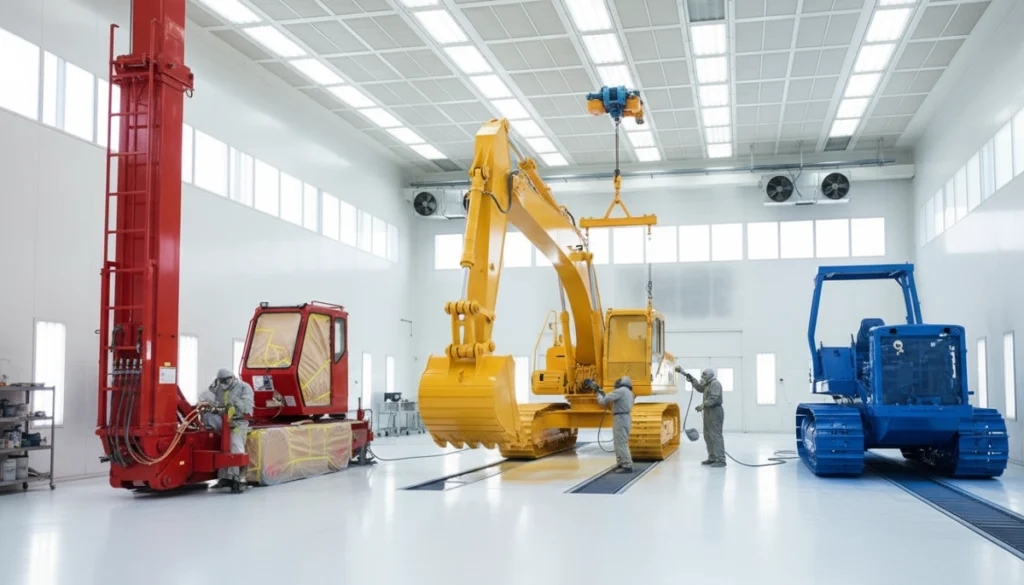
Coating a 30-tonne excavator or a fully extended crane is not the same job as painting a truck. The dimensions are different, the weights are different, the coating materials are different, and the airflow requirements are completely different.
A standard spray booth — even a large one built for trucks — won’t work for this type of equipment. The clearances are insufficient, the floor loading isn’t rated for it, the lighting doesn’t reach the right areas, and the ventilation system can’t manage the volumes of industrial coatings and VOCs involved.
This guide covers what a purpose-built heavy equipment paint booth actually requires: dimensions, airflow, structural demands, compliance, and what to confirm before you commit to a configuration.
What Makes a Heavy Equipment Paint Booth Different
Three things change fundamentally when you move from truck-scale to construction machinery scale.
Dimensions and clearances
An excavator with its arm extended, a crane with a telescopic boom, or an articulated loader at full extension may be wider or taller than they are long. Standard booth configurations don’t account for this. A purpose-built heavy equipment booth is engineered with ceiling heights and door openings designed for the actual geometry of the equipment — not an approximation of it.
Floor loading
The axle loads of bulldozers, graders, and earthmovers are significant. Standard floor grating isn’t designed for this. Reinforced steel grating and high-PSI concrete are required to support the equipment safely without structural failure over time.
Coating volume and VOC load
Industrial epoxies, polyurethanes, and high-solids coatings applied to large surface areas generate substantially more overspray and volatile compounds than automotive or light commercial coatings. The ventilation system needs to move significantly more air — often 30,000 to 100,000+ CFM — to keep vapor concentrations safe and clear overspray from the breathing zone quickly.
Airflow Configurations for Large Equipment
The airflow choice affects finish quality, installation cost, and how well the system manages the heavy overspray loads typical of construction machinery coating.
Crossdraft moves air horizontally from the front to a rear exhaust bank. The most affordable and simplest to install. On equipment with complex geometry — deep crevices, articulated joints, hydraulic cylinders — air moving across rather than away from the surface creates contamination risk in hard-to-reach areas. Works for general utility painting where finish quality is secondary to throughput.
Side-downdraft brings air in through ceiling filters and exits through exhaust ducts at the base of the side walls. No floor pit required, which is often the deciding factor for facilities that can’t excavate. Provides significantly better overspray management than crossdraft because the downward component of airflow pulls contamination away from the equipment surface rather than across it. The right choice for most heavy equipment operations that want professional results without major construction.
Full downdraft moves air straight down from the ceiling into a floor pit. The cleanest configuration — overspray falls directly away from the equipment at every point. Requires concrete pit excavation or a raised floor system. For operations where finish quality is a core business requirement, such as fleet refurbishment for resale or specialty coating work, this delivers the best results.
| Airflow Type | Best For | Pit Required |
|---|---|---|
| Crossdraft | General utility, tight budgets | No |
| Side-downdraft | Large machinery, no excavation | No |
| Full downdraft | High-end finishes | Yes |
Sizing: How to Get the Dimensions Right
The starting point is always your largest piece of equipment — measured at maximum extension, including any attachments, booms, or accessories that would be present during painting.
Add at least 1–1.5 meters (3–5 feet) of clear space on all sides and above the equipment. On construction machinery with tracks, hydraulic cylinders, and articulated joints, painters need to get into awkward positions to reach every surface. Insufficient clearance doesn’t just create airflow problems — it makes the painting job physically harder and produces a worse result.
Door configuration needs careful thought. Standard swing doors aren’t practical for equipment this size. Heavy-duty bi-fold, roll-up, or sliding doors are the norm, and the opening dimensions need to accommodate your widest and tallest equipment with room to maneuver, not just room to fit through.
For drive-through configurations, both ends need adequate straight-line clearance. For single-door setups, the approach area outside the booth needs to handle the full length of the equipment reversing in.
Specific Challenges by Equipment Type
Excavators — articulated joints, hydraulic cylinders, and deep crevices make even coverage genuinely difficult. Paint mist that doesn’t reach these areas causes corrosion at the joints over time, which is where construction equipment typically fails first. Airflow needs to be configured to pull paint particles across rather than away from the machine to ensure penetration into tight spaces.
Cranes and lifting equipment — the main challenge is length. A fully extended telescopic boom can be significantly longer than the machine’s base footprint, and the boom needs to be coated to the same standard as the rest of the structure. End-to-end lighting coverage and consistent airflow velocity along the full length of the booth are essential. Shadow-free lighting along the sides, not just the ceiling, is necessary to see the full surface of a long horizontal structure.
Bulldozers, graders, and loaders — these machines work in abrasive conditions, so the coating needs to be thick, hard, and properly cured. Industrial epoxies and polyurethanes used on wear surfaces require precise temperature control during the curing phase. A booth with integrated climate control and bake cycle capability produces a significantly more durable finish than one relying on ambient air drying.
Filtration for Industrial Coatings
Construction machinery coatings are heavier and stickier than automotive paints. The filtration system needs to be specified for the actual coating volumes involved, not for a light-duty application.
Multi-stage filtration is the standard: pre-filters catch large particles before they reach the main system, primary exhaust media handles the bulk overspray load, and optional carbon filtration stages manage VOC odors and additional emission control if your location requires it.
Filter loading happens faster on heavy equipment jobs than in automotive applications. Use the manometer rather than a fixed schedule — when pressure rises above the recommended range, change the filters regardless of when they were last replaced. For operations running industrial coatings daily, pre-filters typically need changing every 2–4 weeks.
Lighting: Why It Matters More Than People Expect
Construction machinery has a lot of surface area that’s difficult to see — the undercarriage, the interior faces of the bucket or blade, the top of a cab that’s several meters above ground level, and the recesses around any mechanical assembly.
Ceiling-mounted fixtures alone are not sufficient. Side-wall fixtures at multiple heights are necessary to eliminate shadows on vertical surfaces, lower sections, and any areas below the vehicle’s main profile. Painters working on complex equipment need to be able to see into every area they’re coating — missed spots on an excavator arm or crane cab show up as corrosion within months of the equipment going back to work.
All fixtures inside the spray zone must be explosion-proof, rated for hazardous environments. Heavy-duty industrial coatings produce significant solvent vapor loads, and any ignition source inside the booth is a serious risk.
Compliance Requirements
NFPA 33 is the baseline for fire safety. Explosion-proof electrical components throughout the spray zone, integrated fire suppression systems, and proper clearance zones around the booth exterior are all mandatory.
OSHA covers worker protection. Adequate air velocity to keep VOC concentrations below dangerous levels in the breathing zone is the core requirement. Construction machinery coatings often have higher VOC loads than automotive paints, which places greater demands on the ventilation system. Maintenance logs are an OSHA requirement.
EPA regulates what exits the building. High-efficiency filtration capturing paint solids before they reach the exhaust stack is required. Facilities applying high volumes of solvent-based industrial coatings may need to meet additional VOC abatement requirements depending on state and local regulations.
Building permits, electrical permits, and fire marshal approval are required before installation. An air quality permit may also be needed depending on location and coating volume. Start the permit process before you order equipment.
Key Questions to Answer Before You Request a Quote
Getting an accurate quote depends on having clear answers to these before you contact a supplier:
- What’s the largest piece of equipment you’ll be coating, at maximum extension?
- What coating types are you using — high-solids epoxy, polyurethane, waterborne, solvent-based?
- What production rate do you need — how many units per week and what turnaround time?
- How will equipment enter and exit — drive-through or single-door?
- Does your building have three-phase electrical power and adequate gas supply?
- Can your floor be excavated, or do you need a flat-floor solution?
Common Questions
What’s the typical size of a heavy equipment paint booth?
There’s no standard size — it depends on your largest piece of equipment. As a starting point, most construction machinery booths begin at 15–18 meters long. Heights of 6 meters or more are common for equipment with tall cabs or extended booms. Width needs to account for the equipment plus working clearance on each side.
How is airflow different from an automotive booth?
The main difference is volume. Automotive booths typically move 10,000–15,000 CFM. Heavy equipment booths handling industrial coatings on large surface areas typically need 30,000–100,000+ CFM to maintain adequate air velocity and safe vapor concentrations. The fan system, ductwork, and filtration all need to be sized for this.
Can the booth handle both waterborne and solvent-based industrial coatings?
Yes, but the two coating types have different requirements. Waterborne coatings need high air velocity and temperature control to flash off properly. Solvent-based industrial epoxies and urethanes produce higher VOC loads that the exhaust system needs to be rated for. If you use both, the booth specification needs to accommodate the more demanding of the two.
How often do filters need changing?
More frequently than in automotive applications because of the heavier coating volumes. Use the manometer daily — when pressure rises above the operational range, change the filters. Pre-filters typically need replacement every 2–4 weeks for a facility running daily. Exhaust filters need changing based on actual spray hours rather than calendar time.
Tell Us What You’re Coating
Share your equipment types, maximum dimensions, coating specifications, and facility details. Our engineering team will design the right booth and provide a detailed proposal with layout drawings — usually within 48 hours.
Related Pages
- Bus Spray Booth Design Guide →https://sprayboothmanufacturer.com/transit-coach-spray-booth-requirements/
- Truck Paint Booth Guide →https://sprayboothmanufacturer.com/truck-paint-booth-semi-truck-spray-booth-specifications-buying-guide/
- Other related products→https://www.autokemanufacture.com/product
- Contact our sale Team →https://sprayboothmanufacturer.com/contact-us/
✅ CE Certified | ✅ ISO 9001:2015 | ✅ ATEX Available | ✅ Factory Direct | ✅ Ships to 60+ Countries | ✅ 1-Year Warranty | 🔒 HTTPS Secured