Looking for an industrial paint booth? This guide covers ventilation design, booth types, sizing, compliance, and what actually matters before you invest in a heavy-duty finishing setup.
Page URL: https://sprayboothmanufacturer.com/product/
Industrial Paint Booth: Ventilation Design, Types & Setup Guide for Manufacturing
A lot of facilities treat the paint booth as an afterthought — a box they put up to contain the mess. The ones that do tend to deal with rework, compliance notices, and painters working in conditions that aren’t good for anyone.
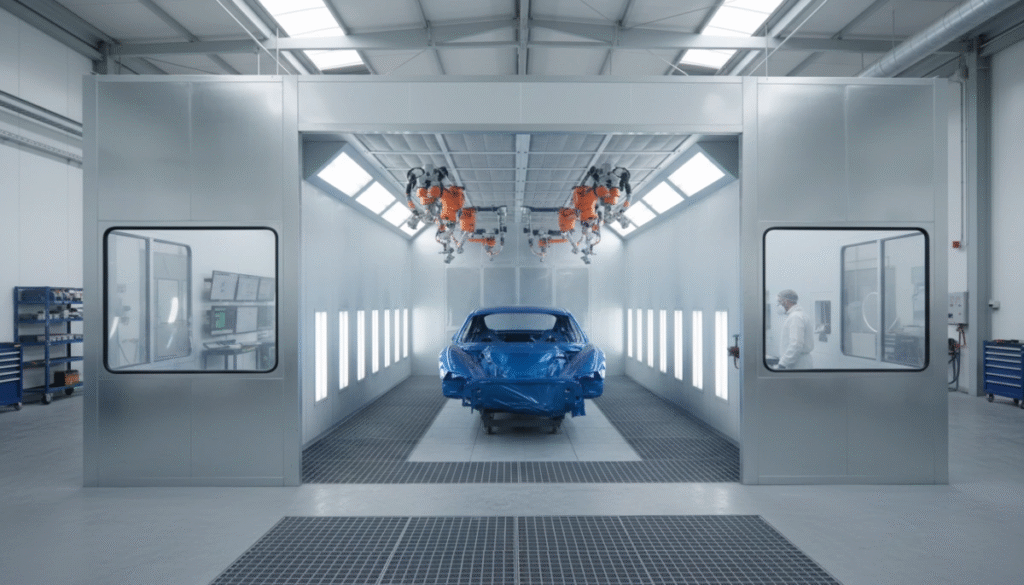
A properly engineered industrial paint booth is a controlled environment where airflow, temperature, and contamination are actively managed. Get it right and you get consistent finish quality, a safer workplace, and a finishing operation that doesn’t bottleneck your production. Get it wrong and you’re dealing with defects, fines, and maintenance headaches that cost more than doing it right from the start.
This guide covers the main booth types, how ventilation design works, what compliance actually requires, and how to size and select the right setup for your facility.
Industrial vs. Automotive Booths: What’s Actually Different
Standard automotive booths and industrial paint booths might look similar from the outside. Inside, the engineering requirements are different in three important ways.
Scale and structural strength. Industrial booths handle heavy machinery, large structural components, aerospace parts, and other equipment that puts real load demands on the floor, frame, and door systems. The construction needs to reflect that — thicker steel, reinforced structures, and doors designed for forklift and crane access.
Airflow volume. Industrial applications often involve larger volumes of coating material, larger surface areas, and longer spray times. The ventilation system needs to move significantly more air — measured in CFM — than an automotive booth to maintain safe vapor concentrations and proper overspray management.
Customization. Automotive booths tend to come in standard sizes because the vehicles they’re built for are relatively predictable. Industrial applications often involve parts or equipment that don’t fit standard templates, which means custom-built enclosures are common.
Booth Types: Which One Fits Your Work
Crossdraft
Air enters through intake filters at the front and moves horizontally to an exhaust bank at the rear. The most affordable option and the simplest to install — no floor work or raised structure required. Works well for standard industrial parts where a highly controlled finish environment isn’t the priority. The limitation is that overspray travels the full length of the workspace before exiting, which increases contamination risk on larger parts.
Downdraft
Air enters through the ceiling filter bank and moves straight down to a floor pit or raised exhaust plenum. Overspray falls away from the part at every point rather than drifting sideways, which gives you a significantly cleaner environment. Fumes and VOCs are pulled immediately away from the painter’s breathing zone rather than building up at head height. Requires either concrete pit excavation or a raised floor system, which adds to installation cost. For high-precision coating work where finish quality is non-negotiable, this is the right configuration.
Side-Downdraft
Air enters through ceiling filters and exits through exhaust vents at the base of the side walls. No pit required, which makes it a practical option for facilities where excavation isn’t possible. Finish quality sits between crossdraft and full downdraft. Works particularly well for large, bulky equipment where you need consistent airflow wrap-around coverage across an irregular shape.
Open-Face Booth
Three walls and an open front. High-volume small-part production where workers need to move parts in and out quickly — conveyor lines, furniture finishing, batch component coating. Smaller footprint, easy loading and unloading, and can be integrated into a larger production line. Not suitable for coating operations that need a pressurized, dust-free environment.
Ventilation Design: Why It Matters More Than Anything Else
If the air isn’t moving correctly, you don’t just get a bad finish — you create a fire and health hazard. Industrial paint booth ventilation design comes down to three things: pressure management, contaminant removal, and climate stability.
Pressure: Positive or Negative
Positive pressure means the booth is supplying more air than the exhaust is removing. This creates a slight outward pressure that prevents unfiltered shop air from being drawn in through door gaps and wall seams. The result is a cleaner internal environment and better contamination control.
Negative pressure means the exhaust removes more air than the intake supplies. This ensures that fumes and VOCs inside the booth can’t escape into the surrounding facility. Used when containing hazardous materials is the priority over keeping the booth interior clean.
Most industrial spray booths operate with slight positive pressure to balance both goals.
Calculating the Right Airflow
The CFM requirement is based on the booth’s dimensions and the target air velocity across the working area:
| Booth Type | Target Air Velocity | Calculation |
|---|---|---|
| Crossdraft | 100 feet per minute (FPM) | Width × Height × 100 = CFM |
| Downdraft | 50–100 FPM | Length × Width × Velocity = CFM |
Getting this right means overspray clears immediately from the painter’s breathing zone and contamination doesn’t have time to settle on wet surfaces. Getting it wrong — either too slow or unevenly distributed — creates dead zones and compliance problems.
Air Makeup Units (AMU)
In a large industrial booth, you can’t just pull air from the surrounding warehouse without replacing it. An AMU draws fresh, filtered air from outside and conditions it before it enters the booth. It does three things:
It prevents dusty warehouse air from being drawn into the spray environment. Heats or cools incoming air to keep coating viscosity and flash times stable, as temperature fluctuations disrupt solvent-based and waterborne coatings alike.
And it controls humidity, which prevents moisture-related defects like blushing in the cured finish.
For any serious industrial finishing operation, an AMU isn’t optional.
Compliance: What the Regulations Actually Require
OSHA focuses on worker protection inside the booth. The requirements cover respiratory hazard management, adequate air exchange rates to keep VOC concentrations below dangerous levels, combustible dust control, and safe working clearances. Maintenance logs showing the booth is operating correctly are a compliance requirement.
NFPA 33 covers fire safety. All electrical components inside the spray zone — lights, fan motors, switches — must be explosion-proof and rated for hazardous locations. Fire suppression system integration is mandatory. The standard also governs booth construction materials and clearance zones around the exterior.
EPA governs what exits the building. High-efficiency filtration capturing paint solids before they reach the exhaust stack is required. Facilities above certain VOC emission thresholds may need additional abatement equipment. Proper disposal of used filters and hazardous waste is also an EPA requirement.
Before installation, you need building permits, electrical permits, and fire marshal approval. Depending on your state and annual paint volume, an air quality permit may also be required. Start this process before you order equipment.
| Regulatory Body | Primary Focus | Key Requirement |
|---|---|---|
| OSHA | Worker safety | Airflow velocity, respiratory protection, dust control |
| NFPA 33 | Fire prevention | Explosion-proof components, suppression systems |
| EPA | Environmental | VOC filtration efficiency, hazardous waste management |
Sizing and Selecting Your Booth
Start with your largest part. Measure the absolute biggest piece you’ll ever need to coat, then add at least 1–1.5 meters of clear space on all sides and above for painter movement and airflow. A booth that fits the part but doesn’t give painters room to work creates real daily problems.
Consider how parts get in and out. If forklifts or overhead cranes are moving equipment into the booth, the door opening needs to accommodate that. Damaged equipment and strained processes come from not thinking this through at the design stage.
Match the booth type to your production model. Batch production — parts in, painted, cured, out — works with any booth type. High-volume continuous production on a conveyor line needs an open-ended layout that keeps the line moving without stopping to open and close doors.
Check your utility infrastructure before you commit. A robust ventilation system and AMU require dedicated electrical capacity and, if gas-fired, adequate gas supply. Find out what your building can actually support before confirming the booth specification.
If your facility has unusual constraints — low ceilings, an irregular floor plan, limited utility access — a custom booth design is often the most practical and cost-effective route rather than trying to force a standard product to fit.
Maintenance: What Keeps the Booth Running Properly
Filters — watch the manometer, not the calendar. When pressure rises above the recommended baseline, change the filters. Clogged intake filters let contamination into the spray environment. Clogged exhaust filters restrict airflow, reduce the quality of the working environment, and eventually cause compliance problems. For a busy industrial facility, exhaust filters typically need changing every few weeks.
Daily cleaning — overspray accumulation on walls and floors is a fire hazard. Peelable booth coating on interior walls makes this much easier to manage — when overspray builds up, peel and reapply rather than scraping. Keep the floor clear of dried paint chips and solvent-soaked materials.
Exhaust fans — overspray on fan blades builds up over time, throwing them out of balance and reducing airflow. Check quarterly and clean as needed. Unusual vibration or noise is an early warning sign.
Door seals — check monthly for cracks or gaps. Leaking seals allow unfiltered air into the booth, undermining the pressure management the whole system depends on.
Lighting covers — wipe down weekly. Paint film on the glass reduces illumination, and reduced light means defects get missed before parts leave the booth.
Common Questions
What’s the difference between an industrial and automotive paint booth? Industrial booths are built for heavier structural loads, higher airflow volumes, larger and more irregular parts, and longer daily operating hours. The construction, filtration, and ventilation systems are all specced differently. The core principle — controlled airflow in a contained environment — is the same.
Do I need a pit for a downdraft booth? You need either a pit or a raised floor system to handle floor-level exhaust. A pit-based system sits flush with the shop floor and is the cleaner option operationally. A raised pitless system avoids excavation and works well for leased facilities or floors that can’t be cut. Airflow performance is the same either way.
How do I know what CFM I need? For a crossdraft booth, multiply booth width by booth height by 100 (feet per minute). For a downdraft booth, multiply booth length by width by your target velocity (typically 50–100 FPM). Your ventilation supplier should confirm this calculation for your specific booth dimensions and provide it in writing.
What permits do I need? Building and electrical permits are standard. Fire marshal approval is required before you can operate. Depending on your state and annual coating volume, an air quality permit for VOC emissions may also be needed. Start this process before you order — permit timelines vary significantly by location.
Tell Us What You Need
Share your part dimensions, coating type, production volume, and facility details. We’ll recommend the right booth type and send a detailed quote with layout drawings — usually within 48 hours.
Related Pages
- Bus Spray Booth Design Guide →https://sprayboothmanufacturer.com/transit-coach-spray-booth-requirements/
- Truck Paint Booth Guide →https://sprayboothmanufacturer.com/truck-paint-booth-semi-truck-spray-booth-specifications-buying-guide/
- Other related products→https://www.autokemanufacture.com/product
- Contact our sale Team →https://sprayboothmanufacturer.com/contact-us/
✅ CE Certified | ✅ ISO 9001:2015 | ✅ ATEX Available | ✅ Factory Direct | ✅ Ships to 60+ Countries | ✅ 1-Year Warranty | 🔒 HTTPS Secured