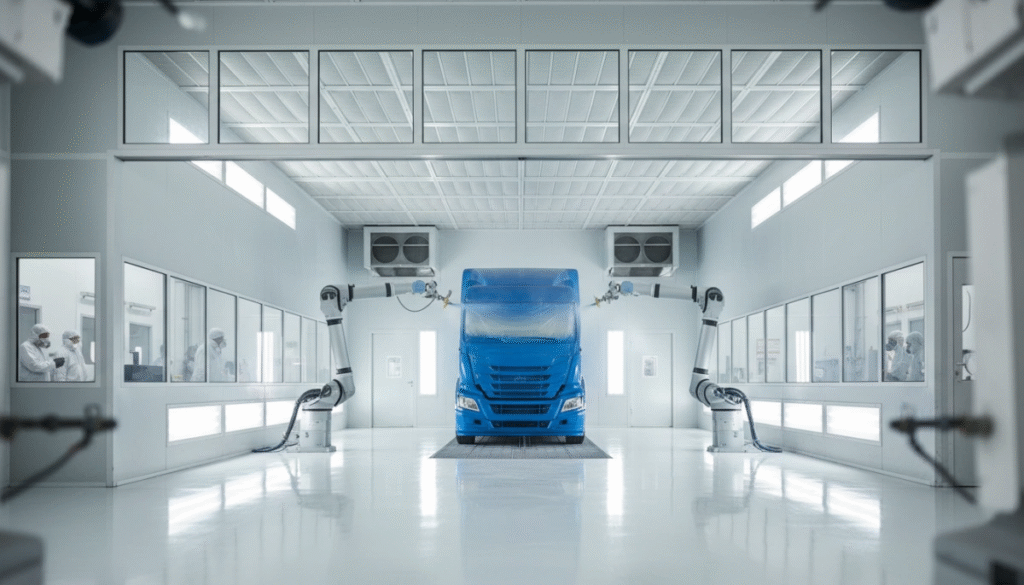
Looking for a truck paint booth? This guide covers trailer paint booth pricing, how to size a booth for semi-trucks and trailers, airflow options, and what affects your total investment.
Page URL: https://sprayboothmanufacturer.com/product/
Truck Paint Booth: Trailer Paint Booth Price, Sizing & Airflow Guide
Painting a semi-truck or a 53-foot trailer in a standard automotive booth doesn’t work. The surface area is too large, the airflow requirements are completely different, and the structural demands of moving heavy commercial vehicles in and out are beyond what a standard booth is built for.
A purpose-built truck paint booth solves these problems — but getting the right one means understanding how sizing, airflow configuration, and installation requirements affect both your upfront cost and your long-term operating expenses.
This guide covers how to size a booth correctly, which airflow configuration fits your work, what drives trailer paint booth price, and what features actually matter for heavy-duty operations.
How a Truck Paint Booth Differs From a Standard Booth
The differences aren’t just about making the booth longer. Three things change fundamentally when you move from automotive to commercial vehicle painting:
Air volume. Painting a 53-foot trailer means moving a tremendous amount of air to keep the environment clean. The fans, ductwork, and filter systems all need to be sized for the cubic footage of a large commercial booth, not a standard car booth.
Structural demands. Heavy commercial vehicles concentrate significant weight on their axles, and the doors, ramps, and floor systems need to be built for that load. Large exhaust systems and multi-level lighting arrays also add structural requirements that a standard booth frame isn’t designed to support.
Lighting. Tall vehicles naturally create shadows that cause painters to miss defects. A truck booth needs fixtures at multiple heights — not just the ceiling — to eliminate dark zones on the upper cab, lower skirts, and chassis.
Airflow Configurations: Which One Fits Your Operation
Downdraft
Air enters through the ceiling filter bank and exits straight down through grates in the floor. This is the cleanest configuration for large vehicle painting — overspray falls away from the vehicle at every point rather than traveling horizontally across it. Best for shops doing high-end commercial fleet work where finish quality is a core part of the business. Requires either a concrete pit or a raised floor system.
Crossdraft
Air moves horizontally from intake filters at the front doors to an exhaust bank at the rear. The most affordable and simplest to install — no floor work required. The tradeoff is that overspray travels the full length of the vehicle before exiting, which requires painters to be careful about their spray patterns on long vehicles. Works well for standard fleet maintenance and industrial coating work where the priority is throughput rather than a show-quality finish.
Semi-Downdraft and Side-Downdraft
If your facility can’t accommodate a floor pit but you want better airflow than crossdraft, these hybrid options are worth considering.
Semi-downdraft brings air in through the ceiling at the front and exhausts through the lower rear wall — better contamination control than crossdraft, no pit required. Side-downdraft brings air down from the ceiling and exits through the lower side walls — similar finish quality improvement, also no excavation needed. Both are practical middle-ground options for facilities with floor constraints.
Sizing: Getting the Dimensions Right
The most important rule is to size based on your largest vehicle — not your average vehicle. A booth that barely fits your biggest trailer is a daily operational problem.
Clearance Requirements
Beyond the vehicle dimensions, painters need room to work. Allow at least 1–1.2 meters of clear space on each side of the vehicle for painters to move with spray equipment. You also need overhead clearance above the vehicle’s highest point — tall exhaust stacks, roof-mounted AC units, and other attachments add height beyond the basic cab or trailer dimension.
Recommended Dimensions by Vehicle Type
| Vehicle Type | Typical Vehicle Length | Recommended Booth Length | Minimum Interior Height |
|---|---|---|---|
| Day cab / box truck | 6–7.6m | 9–12m | 4.3m (14ft) |
| Sleeper cab | 7.6–9m | 12–13.7m | 4.9m (16ft) |
| 53-foot trailer | 16m | 18–24m | 4.9–5.5m (16–18ft) |
For a 53-foot trailer, the booth should be at least 18 meters long — and 22–24 meters if you want proper airflow at both ends without cramping the painters. A minimum interior height of 5 meters gives you clearance above standard trailer height with room for ceiling filters and lighting to function properly.
Building for What Comes Next
A booth that just fits your current fleet will hold you back as soon as you take on a larger contract. Adding 1.5 meters of length or 0.5 meters of height at the design stage costs relatively little — turning down oversized fleet contracts because the booth can’t accommodate them costs a lot more over time.
Trailer Paint Booth Price: What Drives the Cost
Trailer paint booth price varies significantly depending on configuration, dimensions, and installation requirements. Here’s an honest breakdown of what affects the final number.
Base Equipment
Standard pre-engineered sizes for common vehicle types start around $30,000–$60,000 for crossdraft configurations. Custom-engineered booths for 53-foot trailers or specialized heavy machinery — with downdraft airflow, heated AMU, and custom dimensions — typically run $100,000 to $200,000+. Factory-direct pricing from China is generally 30–50% lower than buying through a local distributor for comparable specifications.
What Pushes Price Up
Airflow configuration — crossdraft is the affordable baseline; downdraft requires pit construction and more complex ductwork, which adds cost.
Dimensions — every additional meter of length means more steel panels, more lighting, and more powerful fans to maintain adequate air velocity across the larger space.
Heated air makeup unit (AMU) — adds significant upfront cost but pays back quickly in reduced cure times and higher daily throughput.
Installation Costs to Budget For
The booth price is only part of what you’ll spend. Installation typically involves:
- Concrete work — pit excavation for downdraft booths can add significant cost depending on your floor and location
- Electrical and mechanical — professional wiring, gas line hookups for the AMU, and control panel installation
- Fire suppression — most jurisdictions require a certified system before you can operate
- Permits — building, electrical, and potentially air quality permits depending on your state and annual coating volume
Getting a full landed cost estimate — booth, shipping, installation, and permits — is the only accurate way to compare options.
Ongoing Operating Costs
Beyond the initial investment, a high-volume truck booth has recurring expenses worth factoring in:
Filters — exhaust filters in a busy commercial shop typically need replacing every 2–4 weeks. Intake filters last 3–4 months. This is a real line item in your monthly overhead.
Energy — running large-horsepower fans and a heated AMU costs more than a standard car booth. Variable frequency drives on the fans reduce this during prep and idle stages.
Maintenance — burner servicing, fan belt checks, and seal inspections keep the booth performing. Most shops budget a few thousand dollars per year for preventive maintenance.
Features That Make a Real Difference
Air Makeup Unit (AMU)
This is the single biggest upgrade for throughput. An AMU supplies heated, conditioned air during bake cycles, cutting cure times dramatically compared to ambient air drying. For a fleet operation where booth time is the bottleneck, this pays back quickly in additional vehicles processed per week.
Multi-Stage Filtration
Spraying large commercial vehicles means heavy coating volumes. The filtration system needs to handle this without clogging quickly. Pre-filters extend the life of more expensive high-efficiency intake filters. Exhaust filters protect the outside environment and keep your emissions within EPA limits. A manometer fitted to the system tells you when filters actually need changing rather than guessing.
Lighting Placement
Side-wall fixtures at multiple heights are necessary — not optional — for large vehicle work. Painting in shadow zones leads to uneven coating thickness that only becomes visible once the vehicle is outside. All fixtures must be explosion-proof, rated for Class I Division 2 hazardous locations as a minimum.
Compliance Built In
NFPA 33 requires explosion-proof electrical components throughout the spray zone and an integrated fire suppression system. OSHA requires adequate air velocity to protect painters from VOC exposure. EPA limits what exits the building. A properly built commercial booth meets these by design — ask any supplier for documentation before you buy.
Common Questions
How much does a semi-truck paint booth cost? A standard commercial crossdraft booth starts around $30,000–$60,000. A fully equipped downdraft system with a heated AMU and custom dimensions for 53-foot trailer work typically runs $100,000–$200,000+. Factory-direct pricing from China is usually 30–50% lower than local dealer pricing for comparable specs. Installation, permitting, and shipping add to the total regardless of where you buy.
What size booth do I need for a 53-foot trailer? At minimum, 18 meters long, 5 meters wide, and 5 meters tall. For comfortable painter movement and proper airflow at both ends, 20–24 meters of length is better. Always measure your actual largest vehicle — including any attachments — before confirming dimensions.
Do I need a pit for a downdraft booth? A full downdraft system requires either a concrete pit or a raised floor (pitless) system to handle floor-level exhaust. If excavation isn’t possible, a semi-downdraft or side-downdraft configuration gives you significantly better finish quality than crossdraft without any floor work.
How often do filters need changing in a high-volume shop? Use the manometer rather than a fixed schedule. For a busy operation, exhaust filters typically need changing every 2–4 weeks. Intake filters last around 3–4 months. When pressure rises above the clean baseline reading, change the filters regardless of how long they’ve been in.
Tell Us What You Need
Share your vehicle types, booth length requirements, facility details, and whether a pit installation is possible. We’ll design the right booth and send a detailed quote with layout drawings — usually within 48 hours.
Related Pages
- Bus Spray Booth Design Guide →https://sprayboothmanufacturer.com/transit-coach-spray-booth-requirements/
- Truck Paint Booth Guide →https://sprayboothmanufacturer.com/truck-paint-booth-semi-truck-spray-booth-specifications-buying-guide/
- Other related products→https://www.autokemanufacture.com/product
- Contact our sale Team →https://sprayboothmanufacturer.com/contact-us/
✅ CE Certified | ✅ ISO 9001:2015 | ✅ Factory Direct | ✅ Ships to 60+ Countries | ✅ 1-Year Warranty | 🔒 HTTPS Secured