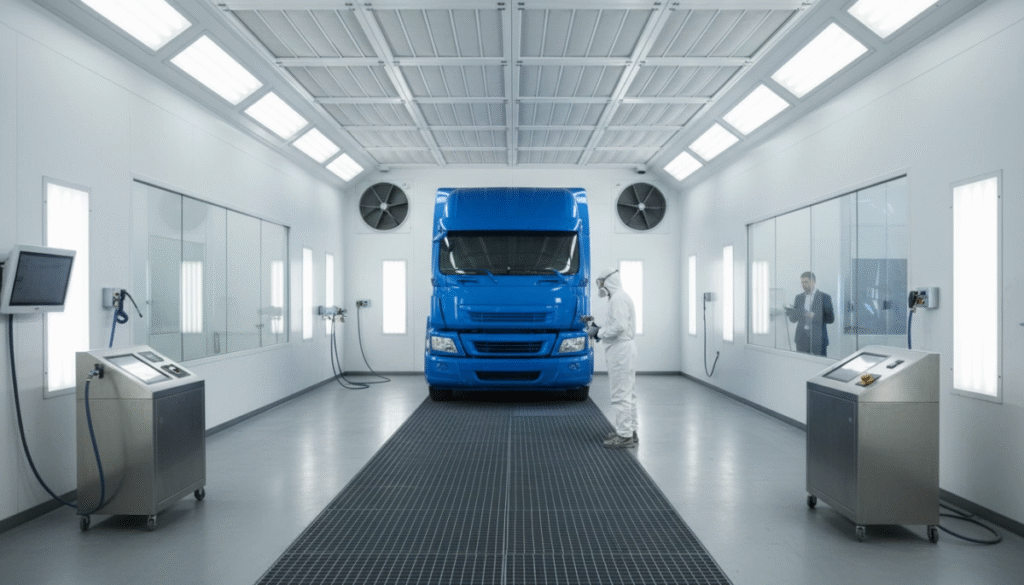
Looking for a truck paint booth? This large vehicle paint booth sizing guide covers dimensions, airflow, compliance, and what to look for before investing in a heavy-duty setup.
Page URL: https://sprayboothmanufacturer.com/product/
Truck Paint Booth: Large Vehicle Paint Booth Sizing Guide for Commercial Fleets
Painting a Class 8 semi-truck is not the same job as painting a car — and a standard automotive booth is not built to handle it.
The surface area alone changes the engineering requirements. Add in the weight of commercial vehicles, the tighter deadlines of fleet maintenance operations, and the higher volumes of coatings involved, and you end up with a set of requirements that a standard booth simply can’t meet.
This guide covers how to size a truck paint booth correctly, how airflow works at commercial scale, what compliance requires, and what to think through before you commit to a configuration.
Why Standard Automotive Booths Don’t Work for Commercial Vehicles
It’s worth understanding exactly where standard booths fall short before looking at what the right setup involves.
Airflow dead zones. A large vehicle body blocks the intended air path in a booth designed for smaller vehicles. Overspray that should be pulling away from the surface instead settles back onto the fresh coat — especially toward the rear of long vehicles.
Inadequate floor loading. Commercial vehicles concentrate significant weight on their axles. Standard booth floors aren’t built for this. A purpose-built truck booth needs reinforced flooring or a properly engineered pit design.
Lighting gaps. Standard lighting heights leave the upper sections of trailers and the lower chassis in shadow. Painting in the dark means uneven coating thickness and defects that only show up once the vehicle is outside.
Throughput bottlenecks. A booth that’s too tight for the vehicle means painters spend more time maneuvering than spraying. In a fleet maintenance operation where every hour matters, this adds up quickly.
Large Vehicle Paint Booth Sizing Guide: Getting the Dimensions Right
The most common mistake when buying a truck paint booth is measuring the vehicle and forgetting the painter. The booth needs to be large enough for the vehicle plus the space painters need to work safely and effectively around it.
The 3-4 Foot Buffer Rule
As a minimum, you need 3 feet of clear space on each side of the vehicle, 3-4 feet above the highest point of the vehicle, and enough front and rear clearance for painters to access the cab, trailer doors, and rear panels without running into intake or exhaust filters.
This isn’t a comfort preference — it’s a working requirement. Tighter than this and airflow becomes inconsistent, which shows up directly in the finish.
Recommended Booth Lengths by Vehicle Type
| Vehicle Type | Typical Vehicle Length | Recommended Booth Length |
|---|---|---|
| Day cab semi | 6–7.6m (20–25ft) | 9–10.7m (30–35ft) |
| Sleeper cab | 7.6–9m (25–30ft) | 12m (40ft) |
| Full trailer combination | 14.6–16m (48–53ft) | 18–20m (60–65ft) |
For RVs, buses, and heavy construction equipment, height and width requirements change too. Roof-mounted AC units on buses and RVs, wide-angle mirrors, side exhaust stacks, and specialized attachments all need to be factored into the booth height and width — not just the base vehicle dimensions.
Standard booth widths for most commercial vehicle applications run 4.3–4.9 meters (14–16 feet). If your fleet includes particularly wide equipment, you’ll need to go wider.
Planning for What Comes Next
A booth that barely fits your current largest vehicle is a problem as soon as you take on a new contract. Adding 1.5 meters of extra length or half a meter of extra height beyond your current largest vehicle costs relatively little at the design stage, but avoids having to turn down high-margin jobs — oversized agricultural equipment, specialized construction machinery — because the booth can’t accommodate them.
Airflow: How It Works in a Large Truck Paint Booth
Crossdraft
Air enters through intake filters at the front and travels horizontally to an exhaust bank at the rear. The most affordable option and the easiest to install — no concrete pit required. The limitation on long vehicles is that overspray travels the full length of the booth before exiting. On a 16-meter trailer, that’s a long way for airborne paint to travel, and some of it inevitably settles back onto sections that were painted earlier. Works well for utility fleet work and repair painting where a perfect finish isn’t always the priority.
Full Downdraft
Air comes straight down from a ceiling plenum and exits through grates in the floor pit. This is the cleanest configuration for commercial vehicles — overspray falls away from every panel at every point along the vehicle’s length, rather than traveling horizontally across it. Requires a concrete pit or raised floor system, which adds to installation cost. For operations where finish quality is a core part of the business, this is the right setup.
Modified Downdraft (No-Pit)
Air enters through the ceiling and exhausts through vents at the base of the side walls rather than through the floor. This delivers significantly better finish quality than crossdraft without requiring concrete excavation. A practical middle option for facilities that can’t do major construction or that lease their space.
Calculating Air Volume
The fan system needs to be sized to maintain 60–100 linear feet per minute of air velocity across the booth’s cross-sectional area. For large booths, this means moving thousands of cubic feet of air per minute — undersized fans create dead zones even in a well-designed booth.
The static pressure capacity of the system also matters. As filters load up over time, resistance increases. A system that’s only marginally powerful enough when filters are clean will underperform long before filters need changing.
Compliance: What the Regulations Require
NFPA 33 covers fire safety. All electrical components inside the spray zone — lights, fan motors, control switches — must be Class I Division 1 or Division 2 rated, meaning they’re sealed against sparks that could ignite flammable vapors. Fire suppression systems — typically dry chemical for commercial truck booths — are mandatory. Maintaining proper clearance zones around the booth exterior is also required.
OSHA covers worker protection. The focus is on keeping VOC concentrations below dangerous levels in the painter’s breathing zone, which comes down to maintaining adequate airflow velocity at all times. Documentation showing the booth is operating correctly is a compliance requirement, not optional record-keeping.
EPA covers what exits the building. High-efficiency filtration capturing paint solids before they reach the exhaust stack is required, and high-volume facilities may need additional VOC abatement measures depending on state and local regulations.
Before installation, you need building permits, electrical permits, and fire marshal approval. Depending on your state and annual coating volume, an air quality permit may also be required. Start this process before you order — permit timelines vary significantly by location.
Lighting and Heating: Where Efficiency Gains Come From
Lighting
Getting even coverage on a 15-meter vehicle with significant height requires fixtures at multiple levels. Ceiling-mounted fixtures alone leave the lower skirts and upper corners of tall cabs in shadow — and defects in shadowed areas don’t get caught until the vehicle is outside.
Side-wall LED fixtures at mid-height and lower height fill these gaps. All fixtures must be explosion-proof, rated for the hazardous environment classification. High-CRI LEDs that replicate natural daylight are the practical choice for accurate color matching during spraying.
Heating and Air Makeup
The biggest throughput bottleneck in any commercial fleet operation is drying time. A properly sized Air Makeup Unit (AMU) that supplies heated, conditioned air during bake cycles dramatically cuts the time a vehicle sits in the booth between coats and after the final coat.
Large vehicles act as heat sinks — it takes more energy to get all that metal up to curing temperature than it does for a passenger car, and it takes longer. The AMU needs to be sized for the actual booth volume and the thermal mass involved, not just the booth’s footprint.
Recirculation mode during baking — retaining and reusing heated air rather than exhausting it and pulling in cold outside air — reduces fuel consumption significantly on large booths running multiple bake cycles per day. Variable frequency drives (VFDs) on the fan motors allow airflow to be adjusted to actual demand at each stage of the process rather than running at full power throughout.
Pricing: What to Expect
Truck paint booth pricing varies significantly depending on size, configuration, and heating:
- Entry-level crossdraft setups typically start between $40,000 and $60,000
- Full downdraft systems with AMU and custom dimensions run $100,000 to $200,000+
Factory-direct pricing from China is typically 30–50% lower than buying through a local distributor for comparable specifications. Installation, electrical work, and shipping are additional costs regardless of where you buy.
Always get a full landed cost before comparing options — the booth price alone doesn’t reflect what you’ll actually spend.
Common Questions
What’s the standard interior height for a semi-truck booth? For most Class 8 trucks, 5–5.5 meters (16–18 feet) of interior height is the standard. Standard trailers run about 4.1 meters tall — you need at least 1 meter of overhead clearance above that for proper airflow distribution and to keep ceiling filters away from exhaust stacks.
Can I paint cars in a truck paint booth? Yes, but it’s rarely efficient. Running a high-volume ventilation and heating system to paint a sedan wastes significant energy. If your shop handles a mix of vehicle sizes, look for a booth with zonal airflow controls that let you run only the sections of the system you actually need.
Do I need a specialized fire suppression system? Yes. NFPA 33 and local fire codes require a certified fire suppression system for any commercial spray operation. Dry chemical systems are the industry standard for heavy-duty truck painting. Your local fire marshal will require a professional installation and regular inspections.
How long does production and delivery take? Standard configurations typically take 30–45 days. Custom-engineered projects run 45–70 days. Sea freight to major US and European ports adds 20–35 days on top of production time.
Tell Us What You’re Working With
Share your vehicle types, fleet dimensions, facility details, and weekly volume. We’ll design the right booth for your operation and send a detailed quote with layout drawings — usually within 48 hours.
Related Pages
- Bus Spray Booth Design Guide →https://sprayboothmanufacturer.com/transit-coach-spray-booth-requirements/
- Truck Paint Booth Guide →https://sprayboothmanufacturer.com/truck-paint-booth-semi-truck-spray-booth-specifications-buying-guide/
- Other related products→https://www.autokemanufacture.com/product
- Contact our sale Team →https://sprayboothmanufacturer.com/contact-us/
✅ CE Certified | ✅ ISO 9001:2015 | ✅ Factory Direct | ✅ Ships to 60+ Countries | ✅ 1-Year Warranty | 🔒 HTTPS Secured