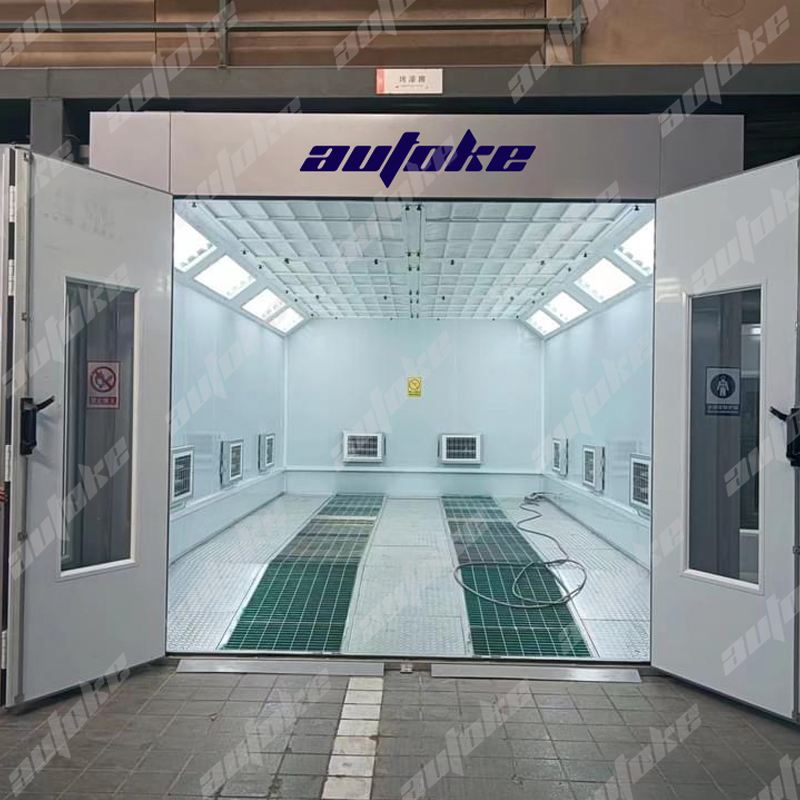
Looking for a truck paint booth? This guide covers semi truck spray booth specifications, airflow types, compliance requirements, and what to look for before you invest.
Page URL: https://www.autokemanufacture.com/Autoke-Truck-Bus-Spray-Booth
Truck Paint Booth: Semi Truck Spray Booth Specifications & Buying Guide
The most common mistake shops make when buying a truck paint booth is treating it like a scaled-up car booth.
It isn’t. The surface area of a semi-truck is several times larger than a passenger vehicle, and that changes the engineering requirements for almost every component — the airflow volume, the heating output, the lighting layout, the structural load, and the floor plan decisions that affect how vehicles move through your facility.
This guide covers what actually matters when specifying a truck paint booth: dimensions, airflow, key components, compliance, and the layout decisions that determine how well the booth fits your operation.
Dimensions: Getting the Size Right
Standard truck booth configurations start at about 4.3m wide and 4.3m tall, with lengths typically ranging from 12m to 18m. But those are starting points, not defaults.
What you actually need depends on your largest vehicle:
- Semi-tractors generally need a minimum of 12m in length
- Full trailers often need 16m to 18m
- Vocational and wide-body trucks may need custom widths that go beyond standard configurations
The length and width of the booth need to account for more than just the vehicle. Painters need at least 1 meter of clear space on each side to move with spray equipment. The height needs to clear not just the cab but any roof-mounted equipment, exhaust stacks, or lights. Get the clearances wrong and you end up with painters working in tight spots, which shows up in the finish.
For custom or unusual vehicles — construction equipment, wide-load utility trucks, specialty rigs — standard sizing won’t work. The booth needs to be engineered around the actual vehicle dimensions.
Airflow: The Most Important Decision
How air moves through a truck paint booth has a bigger effect on finish quality than almost anything else. On a 15-meter vehicle, maintaining consistent airflow from one end to the other is genuinely difficult, and the configuration you choose determines how well you manage it.
Crossdraft moves air horizontally from the front doors to an exhaust bank at the rear. It’s the most affordable option and the easiest to install without any concrete work. The downside on long vehicles is that overspray travels the full length of the booth before exiting, which increases the chance of contamination on freshly painted rear panels. Works well for fleet maintenance where the priority is throughput rather than a showroom finish.
Semi-downdraft brings air in from the ceiling at the front and pulls it toward the lower rear wall. Better airflow coverage than crossdraft, no floor pit required, and a reasonable mid-range cost. A solid choice for general fleet shops that want better quality without the installation complexity of a full downdraft.
Side-downdraft brings air down from the ceiling and exhausts through vents along the lower side walls. Delivers finish quality close to full downdraft without needing to dig into the concrete floor. A good option for shops that lease their space or can’t do major construction.
Full downdraft pulls air straight down from a ceiling plenum through grates in the floor. This is the cleanest airflow configuration because overspray falls directly away from the vehicle at every point along its length. It requires a concrete pit — which adds cost and construction time — but for high-end refinishing work or any operation where finish quality is non-negotiable, it’s the right choice.
| Airflow Type | Best For | Floor Pit Needed |
|---|---|---|
| Crossdraft | Budget fleet maintenance | No |
| Semi-downdraft | General refinishing | No |
| Side-downdraft | High quality, no excavation | No |
| Full downdraft | Best finish quality | Yes |
Semi Truck Paint Booth Specifications: Key Components
Structure and Build Quality
The structure of a truck booth takes more punishment than an automotive booth. Large exhaust fans create significant vibration, ceiling plenums carry the weight of intake filter media and heating units, and heavy vehicles moving in and out stress the floor and door frames over time.
18-gauge galvanized steel panels, nut-and-bolt assembly rather than friction-fit construction, and reinforced roofing are the baseline for a well-built truck booth. The galvanizing matters because paint chemicals and solvent vapors are corrosive over time — lighter or unprotected panels show the effects within a few years.
Heating and the Air Makeup Unit
Curing paint on a large semi-truck properly requires a serious heating system. An air makeup unit (AMU) supplies heated, filtered air into the cabin and controls the temperature throughout the bake cycle.
For truck booths, the AMU needs to be sized for the actual cabin volume — a unit specified for a 7-meter car booth will be undersized for a 15-meter truck booth and will result in long heat-up times and uneven temperatures across the vehicle. Recirculation modes, which retain and reuse heated air during baking rather than exhausting it, make a meaningful difference to fuel consumption at this scale.
Gas burners are the standard choice for truck facilities because of the heat output required. Electric options are available for facilities without gas infrastructure.
Lighting
Getting even, shadow-free light across a vehicle that’s 15 meters long and 4 meters tall requires more than ceiling-mounted fixtures. Without side-wall lighting, the lower panels and chassis areas of a semi-truck stay in shadow, and defects in those areas get missed until the truck is outside.
LED fixtures are the practical choice — they’re brighter, more energy-efficient, and longer-lasting than fluorescent alternatives. All fixtures inside the spray zone must be explosion-proof, rated for Class I Division 2 hazardous locations as a minimum.
Filtration
Three-stage filtration is the standard for a compliant truck paint booth: intake filters to clean incoming air, ceiling filters for a consistent downward flow, and exhaust filters to capture overspray before it exits the building.
Exhaust filters should capture at least 98% of paint solids to meet EPA standards. A manometer (pressure gauge) fitted to the system tells you when filters are restricting airflow — this is how you know when to change them, not by the calendar.
Controls
A touch-screen control panel that lets operators monitor cabin pressure, temperature, and curing cycle time from one interface is standard on modern truck booths. Variable frequency drives (VFDs) on the exhaust fans allow the system to adjust airflow output to actual demand rather than running at full power constantly, which reduces electricity costs on longer operating days.
Pit or No Pit: How to Decide
This question comes up on almost every truck booth purchase.
If your facility is purpose-built, you own the space, and finish quality is a top priority, a pit-based full downdraft system gives you the best results. The excavation adds cost upfront, but the improvement in overspray control is real and consistent.
If you lease your space, can’t do major concrete work, or need to keep installation simple, a side-downdraft or semi-downdraft system is the practical answer. Finish quality is good — not quite as clean as full downdraft, but significantly better than crossdraft — and installation is straightforward on an existing slab.
Drive-Through or Back-In?
Drive-through has doors at both ends. Trucks pull in one side and drive out the other. This is the most efficient layout for high-volume operations because there’s no waiting for a vehicle to reverse out before the next one can enter. It needs more floor space and a clear path at both ends of the booth.
Back-in has a single set of doors. The vehicle reverses in, gets painted, and drives forward out the same end. This works well for lower-volume operations or shops where a drive-through layout isn’t possible. Installation is simpler and it fits into tighter floor plans.
For most dedicated truck refinishing operations doing several vehicles per week, drive-through is worth the additional space requirement. For fleet maintenance shops or specialist repair operations, back-in is a practical and cost-effective layout.
Compliance: What You Need to Know
NFPA 33 is the primary fire safety standard for spray finishing. All electrical components inside the spray zone must be explosion-proof. Fire suppression system integration is required for commercial installations. Proper clearance zones around the booth must be maintained to keep ignition sources away from the spray area.
OSHA 1910.107 covers worker safety inside the booth. Minimum air velocity requirements apply — 100 feet per minute for crossdraft configurations, 50 feet per minute for downdraft. Painters need appropriate respiratory protection, and overspray accumulation on surfaces needs to be managed as both a fire hazard and a slip risk.
EPA 6H NESHAP covers VOC emissions. Multi-stage filtration capturing at least 98% of paint solids is required. High-volume facilities may need additional VOC abatement systems depending on state and local regulations.
Before installation, you’ll need building permits, electrical permits, and fire marshal approval. Having proper engineering drawings and documentation from the manufacturer speeds this process up considerably. Start the permit process before you order — timelines vary significantly by location.
Maintenance: Keeping the Booth Running Well
Filter management is the most important maintenance task. Clogged intake or exhaust filters force the motors to work harder, airflow drops, and finish quality suffers. Use the manometer to track when filters actually need changing rather than guessing based on time.
Keep exhaust pits and side-draft plenums clear of paint buildup. Accumulated overspray on fan blades throws them out of balance, which increases vibration and shortens motor life.
Check door seals weekly. A leaking seal disrupts cabin pressure, lets contamination in, and wastes heated air during bake cycles. On large truck booth doors, seals take more wear than on smaller automotive booths and need more frequent attention.
Variable frequency drives and control panel components should be checked periodically for wear. Catching a failing component early is much less expensive than an unplanned breakdown mid-job.
Common Questions
What’s the minimum size for a semi-truck booth? For a standard semi-tractor, minimum interior length is around 12 meters. Full trailers typically need 16–18 meters. Always add at least 1 meter of clearance on each side and above the vehicle’s highest point for proper airflow and painter access.
Do I need a floor pit for a truck paint booth? Not necessarily. Full downdraft with a pit gives the best finish quality, but side-downdraft and semi-downdraft systems deliver good results on a flat floor. If you lease your space or can’t do concrete excavation, no-pit options are a practical alternative.
What certifications should the booth have? CE marking for European markets, ISO 9001:2015 for quality management, and NFPA 33 compliance documentation for US installations. ATEX certification is required if the booth will be used with coatings in classified explosive atmospheres.
How long does production and delivery take? Standard configurations typically take 30–45 days to produce. Custom-engineered booths run 45–70 days. Sea freight to major US and European ports adds 20–35 days on top of production time.
Tell Us What You’re Working With
Share your vehicle dimensions, facility details, and weekly volume. We’ll put together a layout drawing and a detailed quote — usually within 48 hours.
[Request a Free Quote] [Download Truck Booth Spec Sheet] [Contact us]
Related Pages
- Truck Spray Booth Dimensions →https://www.autokemanufacture.com/Autoke-Truck-Bus-Spray-Booth
- Bus Spray Booth Guide →https://sprayboothmanufacturer.com/transit-coach-spray-booth-requirements/
- Downdraft vs Crossdraft Spray Booth →https://sprayboothmanufacturer.com/which-one-should-you-choose/
- Contact Our Sales Team →https://www.autokemanufacture.com/contact-us.html
✅ CE Certified | ✅ ISO 9001:2015 | ✅ Factory Direct | ✅ Ships to 60+ Countries | ✅ 2-Year Warranty | 🔒 HTTPS Secured