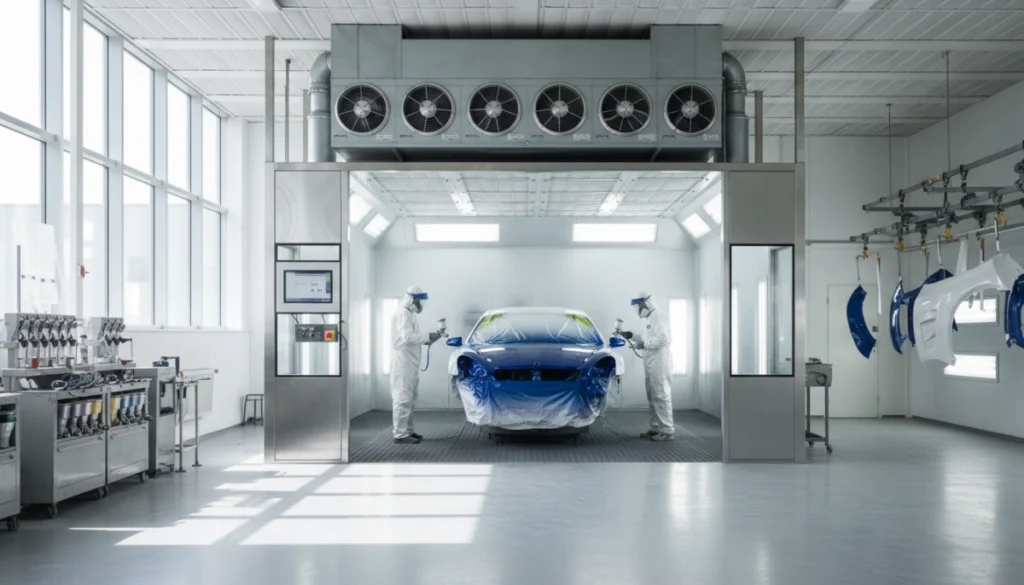
Planning a bus spray booth for your facility? This guide covers dimensions, airflow types, transit coach requirements, compliance, and what to look for before you buy.
Page URL: https://www.autokemanufacture.com/Autoke-Truck-Bus-Spray-Booth
Bus Spray Booth: Design Guide & Transit Coach Requirements
Painting a transit bus or motorcoach is not the same job as painting a car — and a standard automotive booth is not built to handle it.
The surface area alone changes everything. A 40-foot coach has several times more panel area than a passenger vehicle, and that affects the airflow volume required, the heating system size, the lighting layout, and the structural demands on the booth itself. Get any of those wrong and you end up with a contaminated finish, a compliance problem, or both.
This guide covers what makes a bus spray booth different, what transit coach spray booth requirements actually look like in practice, and what to think through before you commit to a configuration.
How a Bus Spray Booth Differs From a Standard Automotive Booth
The differences aren’t just about size. They affect nearly every component in the system.
| Standard Automotive Booth | Bus Spray Booth | |
|---|---|---|
| Typical length | 7m – 8m (24–27ft) | 14m – 18m+ (45–60ft+) |
| Internal height | 2.7m – 3m (9–10ft) | 4.3m – 5.5m (14–18ft+) |
| Air volume | 10,000 – 15,000 m³/h | 30,000 – 60,000+ m³/h |
| Construction | Light-gauge steel | Reinforced structural steel |
The air volume requirement is where most people underestimate the difference. Moving air consistently through a 50-foot space requires industrial-grade fans and a ventilation design that maintains even airflow from one end to the other. If airflow drops off toward the middle or rear of the booth, overspray settles on the finish and you’re back to rework.
The structural demands are also different. A bus spray booth needs to support large-diameter exhaust ducting, extensive lighting arrays, and in many cases integrated man-lifts for painters to reach the roofline safely. The walls need to be built for that load.
Transit Coach Spray Booth Requirements: What You Need to Plan For
Dimensions and Clearances
For a standard 40-foot transit bus, the booth should be at least 15–18 meters long to allow for bumpers and equipment clearance. Width should give painters at least 1 meter of clear space on each side — enough to move with a spray gun and hoses without getting close to a wet panel.
Height is where bus facilities often get caught out. Roof-mounted HVAC units, exhaust stacks, and alternative fuel systems add height beyond the basic vehicle dimensions. For most transit buses, a minimum internal height of 4.5–5.5 meters is required. Double-deckers and coaches with tall rooftop equipment need more.
Articulated buses — the hinged models used on high-frequency transit routes — often exceed 18 meters in length. These almost always require a custom-built configuration rather than a standard product.
Airflow
Maintaining consistent air velocity across a 15-meter vehicle is genuinely challenging. The goal is to keep overspray moving away from the painted surface and out of the painter’s breathing zone at every point along the vehicle — not just near the fans.
The four main airflow options for bus spray booths:
Downdraft — air flows from the ceiling plenum straight down through floor grates. This is the best option for finish quality because overspray falls away from the vehicle at every point. It requires a floor pit or raised floor, which adds to installation cost and complexity. For high-end transit refinishing where finish quality is the priority, it’s the right choice.
Semi-downdraft — air enters from the ceiling at the front and exits toward the lower rear wall. A solid middle-ground option that avoids the floor pit requirement while delivering better results than a straight crossdraft.
Side-downdraft — air enters from the ceiling and exits through vents along the lower side walls. Similar finish quality to full downdraft, no floor pit needed. Good for facilities where excavation isn’t possible.
Crossdraft — air moves horizontally from the front doors to the rear exhaust bank. The most affordable option and the easiest to install in an existing building. Painters need to be careful about their position relative to the airflow to avoid overspray passing over fresh paint. Works well for utility fleet painting where the highest finish quality isn’t always the priority.
Heating and Curing
Heating a 15-meter booth to proper curing temperature takes significantly more power than heating a standard car booth. The system needs to reach 60–80°C and hold it evenly from one end to the other — cold spots on a large flat panel show up in the cured finish.
Gas burners are the standard choice for bus facilities because of the heat output required. The air makeup unit (AMU) regulates both temperature and air supply, and for transit facilities operating year-round in variable climates, a properly sized heated AMU is important for consistent curing times regardless of outdoor temperature.
Heat recovery systems are worth considering at this scale. They capture heat from the exhaust air and use it to pre-warm incoming fresh air, which cuts fuel consumption meaningfully when you’re running long curing cycles on large vehicles every day.
Lighting
Getting even light coverage on a vehicle that’s 15+ meters long and nearly 4 meters tall is harder than it sounds. Ceiling-mounted fixtures alone leave shadows along the lower skirts and at the rear corners. A well-designed bus booth uses fixtures at multiple heights — ceiling, mid-wall, and in some cases ground level — to eliminate dark zones where defects get missed.
All lighting must be explosion-proof and rated for the hazardous environment classification of the spray area.
Layout: Drive-Through or Back-In?
This decision affects your daily workflow as much as any technical specification.
Drive-through booths have doors at both ends. A vehicle enters from one side and exits the other, which keeps traffic moving in one direction without backing up or waiting for the booth to clear. For high-volume facilities painting multiple buses per day, this is the more efficient setup. It needs more floor space and clear access paths at both ends.
Back-in booths have a single set of doors. The vehicle reverses in, is painted, and drives out forward. This works well for lower-volume operations or facilities with limited space where a drive-through layout isn’t possible. Installation is simpler and the exhaust system is easier to run in many existing buildings.
For most transit maintenance facilities doing several vehicles per week or more, drive-through is worth the additional footprint. For specialist repair shops or lower-volume operations, back-in is a practical and cost-effective choice.
Compliance: What the Regulations Actually Require
NFPA 33 covers fire safety for spray finishing operations. All electrical components inside the spray zone — lights, motors, control switches — must be rated for Class I Division 1 or 2 hazardous locations. Fire suppression integration is mandatory for high-volume commercial installations. Clearance zones around the booth are required to keep ignition sources away.
OSHA 1910.107 covers worker health. For crossdraft configurations, minimum air velocity at the work face is 100 feet per minute. For downdraft, 50 feet per minute is the standard. Painters working inside the booth need appropriate respiratory protection, and overspray accumulation on floors and walls needs to be controlled as a fire and slip hazard.
EPA regulations (6H NESHAP) cover VOC emissions. Multi-stage filtration capturing at least 98% of paint solids is required before exhaust air leaves the building. Depending on your state, additional VOC control measures — carbon bed scrubbers or thermal oxidizers — may be required. California and several northeast states have stricter local requirements.
You’ll also need building permits, electrical permits, and sign-off from your local fire marshal before the booth can be used. In some jurisdictions, air quality management district (AQMD) permits are a separate step. Starting this process before you order equipment is the right approach — permit timelines vary significantly by location.
Key Features to Look For
Variable frequency drives (VFDs) on the fan motors allow the system to adjust airflow to actual demand rather than running at full power constantly. On a system moving 40,000+ m³/h of air, this makes a real difference to monthly energy costs.
Integrated man-lifts matter for painter safety and efficiency. Reaching the roofline of a 4-meter bus with a ladder is slow and creates safety risks. Three-axis pneumatic lifts built into the booth structure let painters work at height and move along the vehicle without stopping to reposition equipment.
Multi-stage filtration — pre-filters, ceiling filters, and exhaust filters — as standard. Pressure monitoring (manometer) on the system tells you exactly when filters need changing based on actual performance rather than guesswork.
PLC control panel for automated management of airflow, baking cycles, and temperature. Reducing manual adjustment reduces error and makes curing cycles more consistent.
Maintenance: What to Stay On Top Of
For a high-volume bus painting facility, the maintenance schedule looks different from a standard automotive booth:
Filters — pre-filters should be checked weekly and replaced every 150–200 operating hours. Exhaust filters should be checked after every 50–100 spray hours. Use your manometer — when the pressure reading goes out of range, change the filters regardless of the schedule.
Door seals — the entry and exit doors on a bus booth are large, and the gaskets take more wear than on a standard booth. Check them monthly. A leaking seal lets dust in and heated air out, which shows up in both finish quality and energy bills.
Heating and sensors — temperature sensors and airflow sensors should be calibrated quarterly. An inaccurate sensor means your curing cycles aren’t hitting the specs the paint manufacturer requires, which affects adhesion and durability.
Mechanical components — fan bearings, door hinges, and drive-through tracks need regular lubrication to prevent wear and unplanned downtime.
Common Questions
How much space does a transit coach spray booth need? For a standard 40-foot bus, plan for at least 15–16 meters of interior length, 5–5.5 meters of width, and 4.5–5.5 meters of height. Articulated buses at 18 meters or more need custom-built configurations. Always add at least 1 meter of clearance above the vehicle’s highest point for lighting and airflow to function properly.
What’s the best airflow type for painting buses? If finish quality is the priority and your facility can accommodate a floor pit, full downdraft gives the cleanest result. If you can’t excavate, side-downdraft is a strong alternative that delivers similar quality without the concrete work. Crossdraft is the most practical and affordable option for utility painting where finish requirements are less demanding.
Can an existing car booth be retrofitted for buses? Technically possible, but rarely worth it. You’d need to recalculate and upgrade the entire ventilation system, heating, lighting, and likely the structure as well. The cost of a proper retrofit usually gets close to the cost of a purpose-built booth, and you end up with a compromise rather than a system engineered for the job.
Do we need a heated air makeup unit? For a commercial transit facility, yes. A heated AMU keeps curing temperatures stable regardless of outdoor conditions. In winter, an unheated system can significantly extend curing times and create temperature inconsistencies across large panels. For year-round operations, it pays for itself quickly.
Tell Us About Your Fleet
Send us your bus dimensions, facility details, and production volume. We’ll design the right booth for your operation and provide a detailed proposal with layout drawings — usually within 48 hours.
[Request a Technical Proposal] [Download Bus Booth Spec Sheet] [Contact us]
Related Pages
- Downdraft vs Crossdraft Spray Booth →https://sprayboothmanufacturer.com/which-one-should-you-choose/
- Spray Booth Manufacturer in China →https://www.autokemanufacture.com/product
- Contact Our Export Sales Team →https://www.autokemanufacture.com/contact-us.html
✅ CE Certified | ✅ ISO 9001:2015 | ✅ ATEX Available | ✅ Factory Direct | ✅ Ships to 60+ Countries | ✅ 1-Year Warranty | 🔒 HTTPS Secured
One Response