
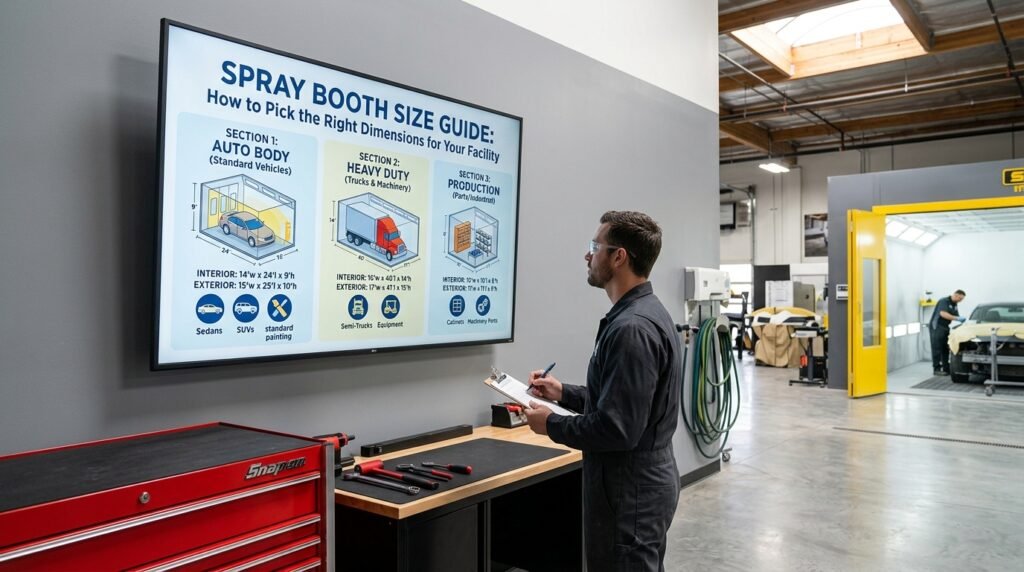
The “Envelope” Method: The Golden Rule of Sizing
We always tell clients that a successful installation begins with the Part Envelope. Before looking at floor plans, you must define the maximum volume of the largest object you intend to spray. If you size your booth for today’s average job without considering your largest potential workpiece, you’re creating an immediate ceiling for your business growth.
Calculating Your Maximum Part Envelope
To find your baseline, measure the absolute maximum dimensions of your largest workpiece:
- Total Length: From the furthest protruding points (e.g., bumpers, hitches, or overhanging industrial components).
- Total Width: Include mirrors, open doors, or extended hardware.
- Total Height: Measure from the floor to the highest point, including roof racks or top-mounted gear.
The 3-to-5-Foot Minimum Clearance Rule
In our experience, the “Minimum Clearance Rule” is non-negotiable. I recommend a 3-to-5-foot (1–1.5m) buffer between the part and the booth walls/ceiling. This isn’t just “extra” space; it is functional space required for:
- Painter Maneuverability: Your technicians need enough room to maintain a consistent spray gun distance (typically 8–12 inches) while moving fluidly around the part.
- Airflow Velocity: A “tight” booth creates air turbulence and “dead zones,” which leads to overspray wrap-around and poor finish quality.
- Safety & Code Compliance: You must ensure clear paths for emergency egress and fire suppression system functionality.
Accounting for Essential Auxiliary Equipment
Don’t make the mistake of measuring an empty room. Your internal dimensions must accommodate the “clutter” of a professional workflow:
- Parts Trees and Rolling Stands: Essential for painting panels and small components alongside the main part.
- Ladders and Scaffolding: Necessary for reaching the roofs of high-top vans or heavy machinery.
- Hose Management: Providing enough floor space so air hoses don’t drag through wet paint or snag on equipment.
Standard Industry Dimensions vs. Application Needs
When we talk about choosing a standard 7m automotive booth versus a custom industrial setup, it really comes down to your daily workflow. We have found that picking a size based on your most common job—not your smallest—prevents the massive headache of turning away high-revenue work because it won’t fit through the doors.
Automotive and Collision Repair: 7m vs. 9m
In the American market, the 7m (23ft) booth is the industry standard. It’s perfect for sedans and compact cars. However, if you’re frequently seeing Ford F-150s or large SUVs in your shop, I highly recommend the 9m (30ft) “Luxury” footprint.
- 7m Booth: Best for standard passenger vehicles and high-turnover collision repair.
- 9m Booth: The go-to for full-size pickups, cargo vans, and extended-wheelbase vehicles.
Heavy Duty and Fleet: Trucks, Buses, and Rail
For heavy-duty truck booths, we’re looking at lengths starting at 12m (40ft) and scaling up to 16m (52ft) or more. These facilities need extra width to accommodate mirrors and wide-body trailers while leaving enough material handling space for the painter to move safely.
Woodworking and Small Parts
For furniture and cabinetry, you don’t always need a massive footprint. We offer modular footprints that focus on high-speed throughput. These are often smaller but require specialized industrial finishing equipment layouts to handle a high volume of small components like cabinet doors or chair frames.
Autoke Standard Size Comparison Table
Use this quick reference to see how our internal dimensions stack up against common vehicle types:
| Model | Internal Length | Internal Width | Ideal Application |
|---|---|---|---|
| Model 6m | 6.0m (19.6ft) | 3.9m (12.8ft) | Small parts, motorcycles, and compact cars. |
| Model 7m | 6.9m (22.6ft) | 3.9m (12.8ft) | Standard automotive sedans and crossovers. |
| Model 9m | 9.0m (29.5ft) | 4.5m (14.7ft) | Sprinter vans, SUVs, and long-bed pickups. |
| Model 12m | 12.0m (39.4ft) | 5.0m (16.4ft) | Box trucks, buses, and light industrial equipment. |
Choosing the right working envelope ensures you aren’t paying to heat empty space, but you also aren’t cramped when spraying a full-size vehicle.
How Airflow Design Dictates Your Spray Booth Height
When I’m helping a client map out their shop, height is usually where we run into the most surprises. It’s not just about the clearance of your tallest vehicle; it’s about how much room the air needs to move properly. Your chosen airflow style—whether it’s pulling air down or across—is the biggest factor in determining your facility’s vertical requirements.
Downdraft Systems: Pit Depth vs. Plenum Height
A downdraft spray booth provides the cleanest finish by pulling overspray straight down, but it’s a “space hog” vertically. You have to account for two major components:
- The Plenum: This is the pressurized “attic” of the booth that distributes air. It usually adds 2 to 3 feet to the top of your internal working height.
- The Pit or Basement: If you can dig into your shop floor, a concrete pit hides the exhaust system. If you can’t dig, you’ll need a raised steel basement (typically 12–18 inches), which pushes the entire booth closer to your ceiling.
Crossdraft and Semi-Downdraft: Low-Profile Solutions
If you’re working in a building with limited overhead clearance, we usually recommend a crossdraft or semi-downdraft setup.
- Ceiling Savings: These designs don’t require a pit or a basement, allowing the booth to sit directly on your shop floor.
- The Trade-off: While you save on height, you’ll likely need more floor length. Since the air moves horizontally, you need extra space for the filter banks at the front or rear of the booth to ensure the airflow velocity stays consistent across the part.
The Impact of Size on CFM and Fan Power
The physical dimensions of your booth directly dictate your mechanical costs. Every extra foot of height or width increases the total volume of air that needs to be moved.
- CFM (Cubic Feet per Minute): To meet safety and finish standards, air must move at a specific speed (usually 100 FPM).
- Energy Costs: A booth that is unnecessarily large requires a higher CFM rating, meaning bigger fans, more powerful motors, and more fuel to heat the incoming air.
Pro Tip: We always advise sticking to the tightest “envelope” possible that still allows for painter maneuverability. If you over-size the booth height just “to be safe,” you’re essentially paying to heat and move air in a dead space you aren’t even using.
Planning Your Facility Footprint: Beyond Internal Dimensions
When using a spray booth size guide, many owners make the mistake of only measuring the interior workspace. To get a realistic view of how a booth fits into your shop, you have to account for the thickness of the structure and the “life support” systems that keep it running.
External Components and Wall Thickness
We build our booths using 5cm (approx. 2-inch) high-density rock wool panels. While these provide excellent thermal insulation and fire resistance, they—along with the external structural supports—add to the total internal vs. external dimensions. Always add at least 10–15cm to your internal width and length calculations just to account for the “skin” of the booth.
The Mechanical Unit Footprint
Your airflow system isn’t invisible. The mechanical unit—which houses the intake fans, exhaust cabinets, and burners—is a substantial piece of equipment.
- Space Requirement: Typically, the heater box and fan assembly require a footprint of approximately 1.1m x 2.2m (3.6ft x 7.2ft).
- Placement: Depending on your shop layout, this unit can be placed on the side or the rear. You must ensure your facility footprint has enough “breathing room” for these components to pull in fresh air and exhaust safely.
The “Hazardous Zone” and Safety Clearance
Meeting NFPA 33 compliance and local fire codes is non-negotiable for insurance and safety. You cannot push a spray booth flush against a wall or other equipment if it interferes with code-mandated clearances.
- The 2.0m Rule: You must maintain a 2.0m (approx. 6.5ft) clearance around all booth openings.
- Why it Matters: This “Hazardous Zone” keeps ignition sources away from potential overspray and ensures painters have a clear path for emergency egress.
- Maintenance Access: Beyond code, you need this space to change filters, service the mechanical unit, and perform routine inspections without feeling cramped.
Planning for these external factors ensures that once the booth arrives, it actually fits your floor plan without forcing expensive facility modifications.
Efficiency vs. Volume: Why Bigger Isn’t Always Better
When picking dimensions from a Spray Booth Size Guide, many shop owners assume that more space is always an advantage. However, I’ve found that “going big” without a plan usually backfires. The goal is to find the sweet spot where your booth is large enough to handle your workload but small enough to remain energy efficient.
The “Energy Drain” of Oversized Booths
Operating an oversized booth is one of the fastest ways to eat into your profit margins. If your internal dimensions are significantly larger than your parts require, you are essentially paying to move and heat dead air.
- Heating Costs: You’ll see a massive spike in gas or electric usage because the heater box has to work overtime to reach curing temperatures.
- Electricity Waste: Larger booths require higher airflow velocity (CFM). This means bigger fans and higher horsepower motors that pull more juice from the grid every minute they’re running.
- Extended Cycle Times: It takes longer to purge air and reach a stable temperature, slowing down your total daily output.
The “Bottleneck” of Undersized Booths
On the flip side, going too small creates a physical bottleneck. If your team is fighting for space, your quality will suffer.
- Painter Fatigue: When a painter is cramped, they can’t maintain a consistent spray gun angle. This leads to reaching, stretching, and eventually, mistakes.
- Finish Defects: Lack of material handling space often leads to “rub-offs” or overspray settling on wet surfaces because the airflow can’t circulate properly around the workpiece.
- Safety Hazards: Tight spaces make it difficult to maneuver ladders or parts trees, increasing the risk of accidents.
Future-Proofing Your Facility
I always tell my clients to size for where their business will be in five years, not just what’s on the floor today.
- Market Trends: If you currently spray small parts but plan to move into heavy-duty truck booths or larger industrial components, investing in a modular 9m “luxury” footprint now prevents a costly facility teardown later.
- Versatility: A slightly larger working envelope allows you to spray multiple small parts simultaneously on a rack, which can actually improve high-throughput efficiency compared to a cramped, “single-part” booth.
Custom Engineering: The Autoke Advantage
Sometimes “standard” just doesn’t cut it. If you are dealing with massive machinery, specialized aircraft components, or odd-shaped industrial gear, we specialize in building what the catalog can’t provide. We’ve designed and delivered custom industrial finishing equipment for components up to 12 meters (39 feet) wide, ensuring your facility isn’t limited by a pre-set mold.
Solutions for Irregular Industrial Components
We don’t believe in forcing your workflow into a box that’s too small. If your project involves oversized heavy-duty parts or non-linear production lines, we engineer the internal dimensions to match your specific working envelope.
- Wide-Span Engineering: Support for parts up to 12m wide without sacrificing structural integrity.
- Specialized Geometry: Custom heights and lengths tailored to your unique material handling systems.
- Application-Specific Airflow: Custom fan and ducting layouts to maintain airflow velocity regardless of the booth’s shape.
From Concept to CAD in 48 Hours
In the US market, I know that speed is everything. You can’t afford to wait weeks just to see if a design fits your floor plan. We’ve streamlined our engineering process to provide technical drawings and CAD models within 24–48 hours. This allows you to:
- Verify the external dimensions against your facility’s footprint.
- Plan for NFPA 33 compliance and clearance zones immediately.
- Get accurate quotes to keep your project moving without the typical back-and-forth lag.
Global Compliance and Safety Standards
A custom size should never mean a compromise on safety. Every booth we build, no matter how irregular, is designed to meet rigorous global and local standards. We ensure your custom build is ready for inspection the day it’s finished.
| Standard | Coverage | Importance For US Facilities |
|---|---|---|
| NFPA 33 | Fire safety for spray application | Critical for insurance and local fire marshal approval. |
| OSHA | Worker safety and ventilation | Ensures painter maneuverability and health standards. |
| CE / ISO | Manufacturing quality | Guarantees the build quality of panels and mechanical units. |
| ATEX | Explosion-proof equipment | Optional add-on for high-risk hazardous environments. |
Spray Booth Size Guide: FAQ
Choosing the right working envelope is the most critical decision you’ll make when setting up your shop. I’ve put together the answers to the most common questions we hear from facility owners looking to optimize their floor plan.
What is the standard size of a car spray booth?
For most collision centers in the United States, the standard 7m automotive booth is the go-to choice. Internally, this translates to roughly 23ft long, 13ft wide, and 9ft high. This footprint handles everything from compact cars to standard pickups. If you frequently work on extended-cab trucks or large SUVs, I usually recommend stepping up to a 9m (30ft) “Luxury” length to ensure better overspray containment.
How much clearance do I need for painter maneuverability?
I follow a strict 3-to-5-foot buffer rule around the entire part.
- 3 feet: The bare minimum for a painter to move without brushing against wet paint.
- 5 feet: The ideal distance for maintaining consistent airflow velocity (CFM) and ensuring the spray gun stays at the perfect angle.
Without this clearance, you risk “dead air” pockets that cause finish defects and trap fumes.
Does a downdraft booth require more height than a crossdraft booth?
Yes. A downdraft system typically requires more vertical space because of the intake plenum located in the ceiling. If you are dealing with ceiling height restrictions, a crossdraft or semi-downdraft model is often a better fit since they pull air horizontally or diagonally, reducing the need for overhead ductwork space.
How do I calculate the external dimensions based on internal needs?
To find your total facility footprint, you have to look beyond the internal workspace:
- Wall Thickness: Add at least 4 inches (10cm) to the width and length to account for the high-density rock wool panels and structural skin.
- Heater Box Footprint: Budget an additional 4ft x 8ft (1.1m x 2.2m) on one side or the rear for the mechanical unit and burners.
- Safety Clearances: Ensure you have the 2.0m (approx. 6.5ft) hazardous zone clearance around all openings to remain NFPA 33 compliant.
| Component | Added Dimension (Approx.) |
|---|---|
| Wall Panels | +4 inches total |
| Mechanical Unit | +4 feet (width or length) |
| Ductwork/Clearance | +3 to 6 feet (height) |
Getting these measurements right the first time prevents costly installation delays and ensures your industrial finishing equipment operates at peak efficiency.