
Detailed Explanation of the Spray Booth Air Circulation System
Automotive spray booths and furniture spray booths are designed to operate under stable temperature and humidity conditions during both spraying and baking processes.
During spraying, clean air quality directly affects paint finish quality, while during baking, stable airflow speed and temperature are critical for proper curing.
At the same time, a well-designed air circulation system also plays an important role in protecting operator health and ensuring workplace safety.
This article explains the spray booth air circulation system from the perspectives of working principle, airflow path, system components, and practical advantages.
1. What Is a Spray Booth Air Circulation System?
A spray booth air circulation system refers to the complete process of air intake, airflow movement, filtration, exhaust, and recirculation inside the spray booth.
Its purpose is to create a clean, controlled, and safe environment for spraying and baking operations by continuously managing air quality and airflow stability.
2. Working Principle of the Spray Booth Air Circulation System
2.1 Fresh Air Intake and Pre-Filtration
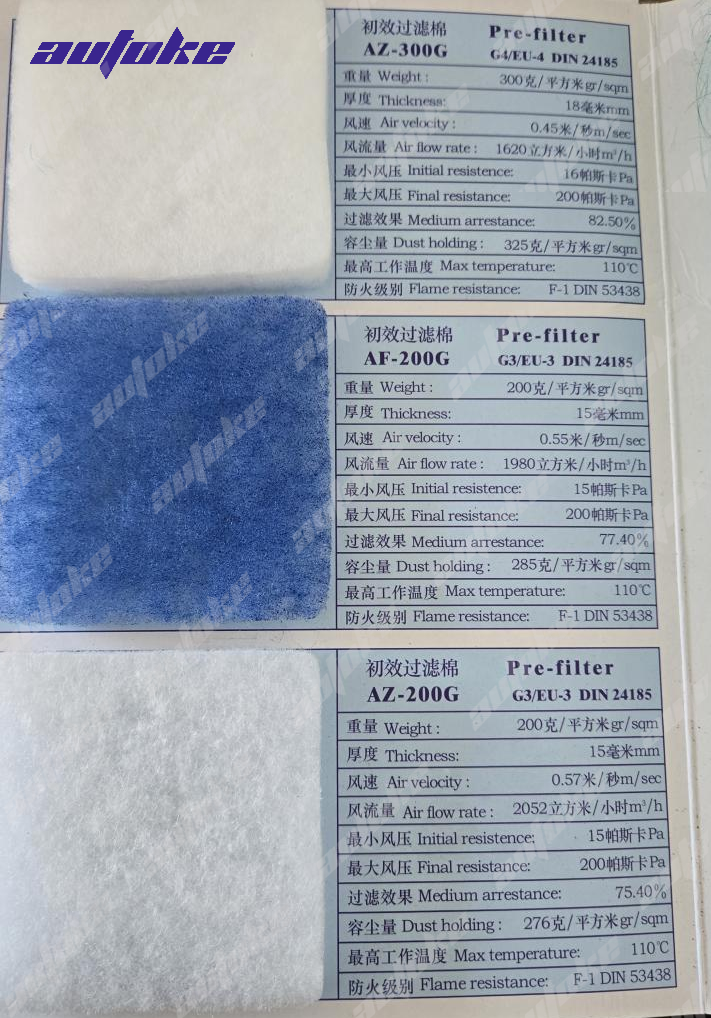
Fresh air is first drawn from outside the spray booth and passes through pre-filters that remove large dust particles and impurities.
This step is the foundation of a clean painting environment and effectively reduces surface contamination and repainting rates.
-
Captures large particles such as hair and fibers
-
Particle size: >10μm
-
Filtration efficiency: >82.5%
2.2 Ceiling Air Supply (Downdraft Structure)
After pre-filtration, air passes through ceiling filters that remove fine dust particles down to 1μm, with filtration efficiency up to 98%.
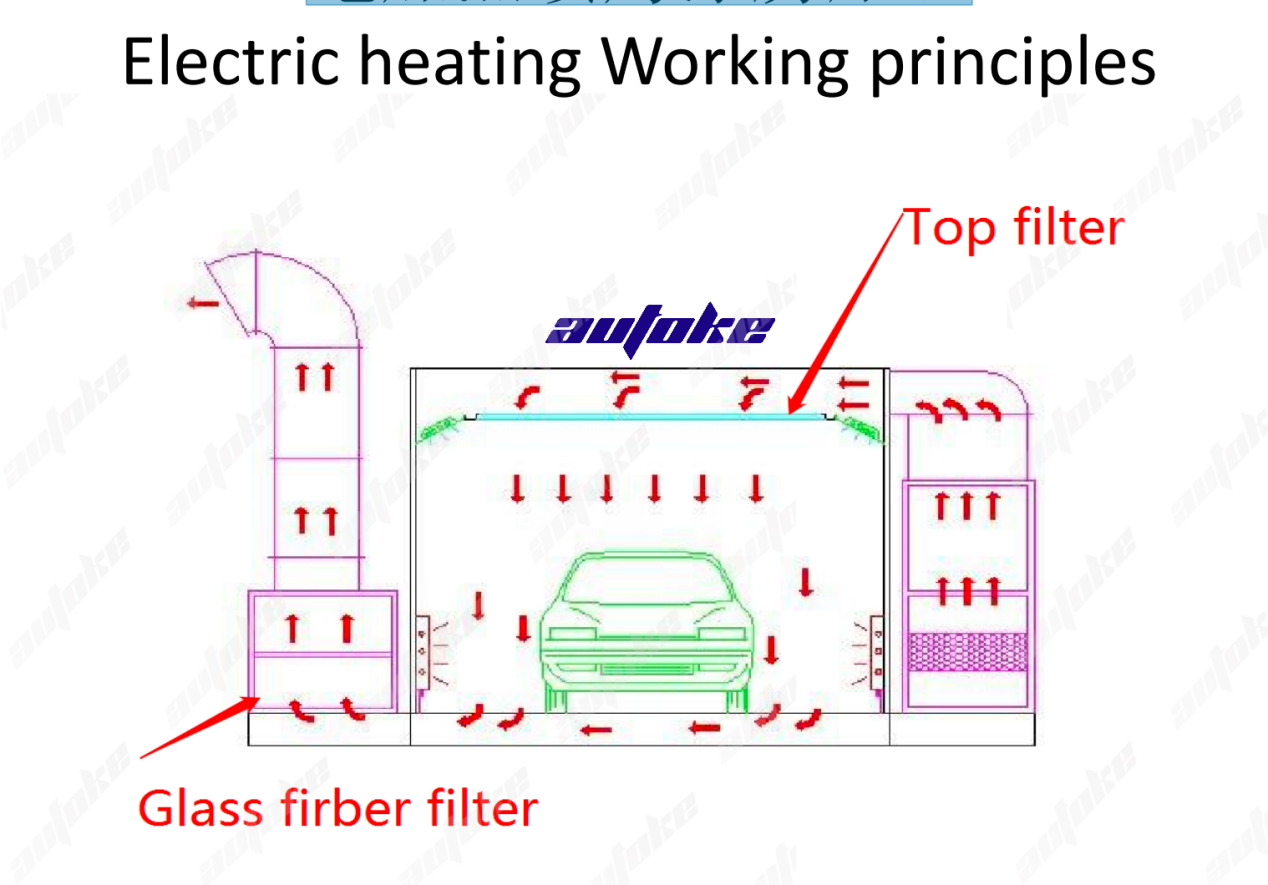
The filtered air is then heated and supplied into the booth from the top, flowing from top to bottom to uniformly cover the entire vehicle surface.
This airflow pattern prevents paint mist from lingering around the vehicle and significantly improves paint uniformity and surface gloss.
Most professional spray booths today adopt:
-
Downdraft airflow systems
-
Semi-downdraft airflow systems
Ceiling Filter (White) – Technical Data
-
Filter class: F5 / M5 (EN779), EU5 (EUROVENT)
-
Particle size: >1μm
-
Flame retardant: F1 (DIN 53438), B1 (GB/T17591-2006)
-
Average efficiency: ≥98% (ASHRAE 52.1-1992)
-
Final resistance: 400 Pa (recommended)
-
Humidity resistance: <100% RH
-
Dust holding capacity: 600 g/m²
-
Instant temperature resistance: <120°C
-
Continuous temperature resistance: ≤100°C
2.3 Airflow in the Spraying Area
During spraying, airflow continuously surrounds the vehicle and quickly removes excess paint mist and solvent vapors.
Typical operating parameters:
-
Air velocity: 0.25–0.30 m/s
-
Pressure difference (inside vs. outside): 10–80 Pa
Stable airflow and pressure help prevent:
-
Paint sagging
-
Color inconsistency
-
Secondary paint mist attachment
2.4 Bottom Exhaust and Paint Mist Filtration
At the bottom of the booth, air carrying paint mist passes through floor grilles or side grilles into the exhaust system.
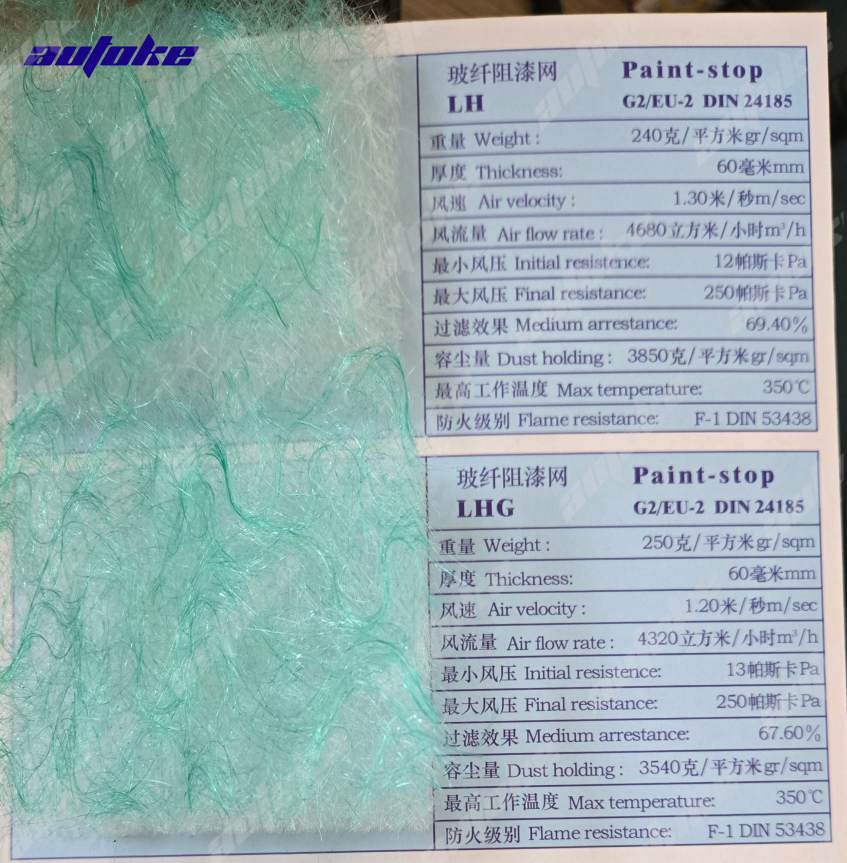
Fiberglass paint-stop filters capture paint particles before air continues toward exhaust or recirculation channels.
Floor Filter (Blue) – Technical Data
-
Filter class: G3 (EN779), EU3 (EUROVENT)
-
Filter objects: paint mist, oil mist, dust particles
-
Paint mist efficiency:
-
AR-50 ≥90%
-
AR-75 ≥95%
-
AR-100 ≥98%
-
-
Flame retardant: F1 (DIN 53438), B1 (GB/T17591-2006)
-
Final resistance: 200 Pa (recommended)
-
Humidity resistance: <100% RH
-
Temperature resistance: <170°C
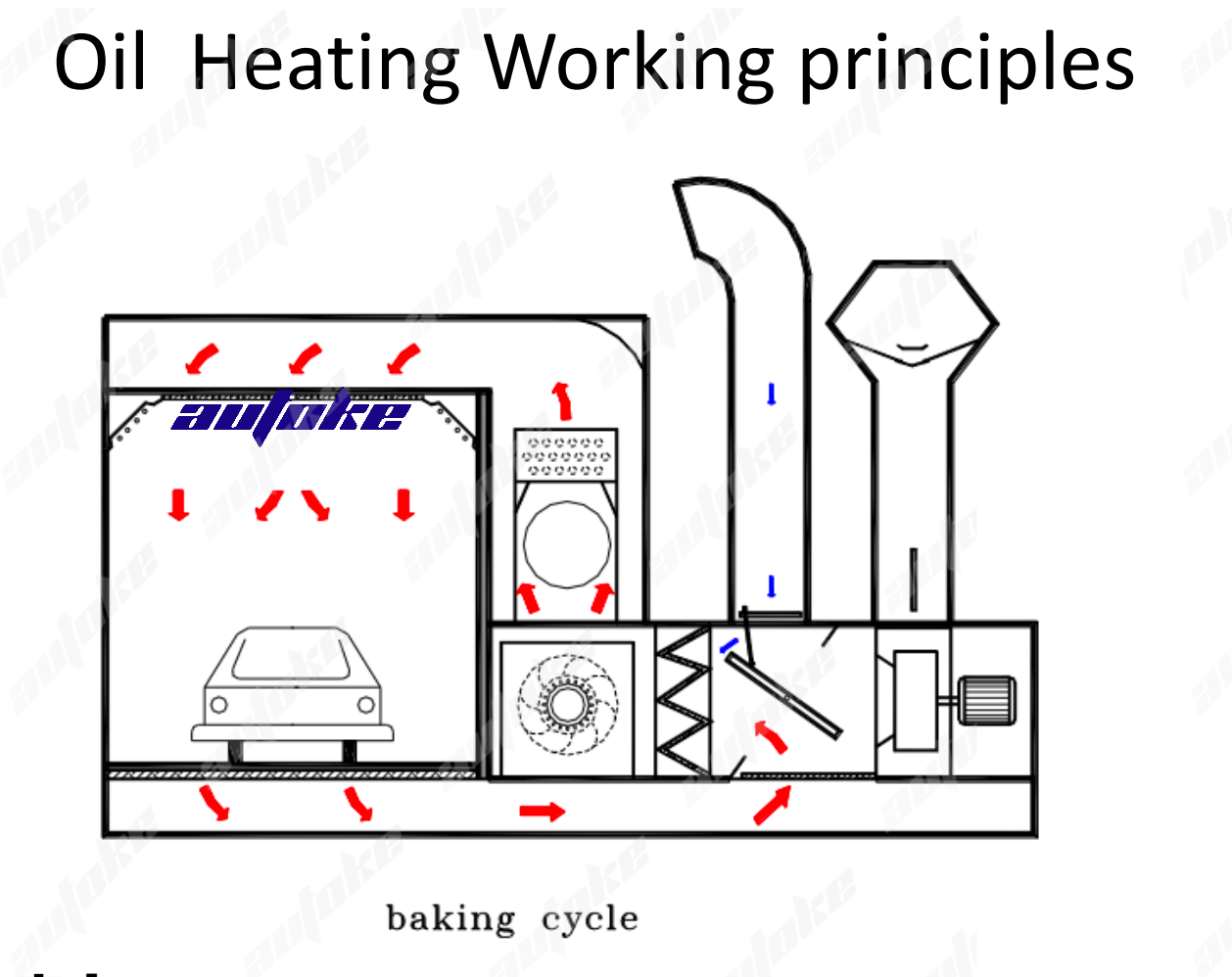
2.5 Exhaust and Air Recirculation
Depending on booth design:
-
Part of the air is exhausted outdoors
-
Part of the air enters the recirculation duct for reheating
This design ensures safety while significantly reducing energy consumption.
3. Air Circulation System in Baking Mode
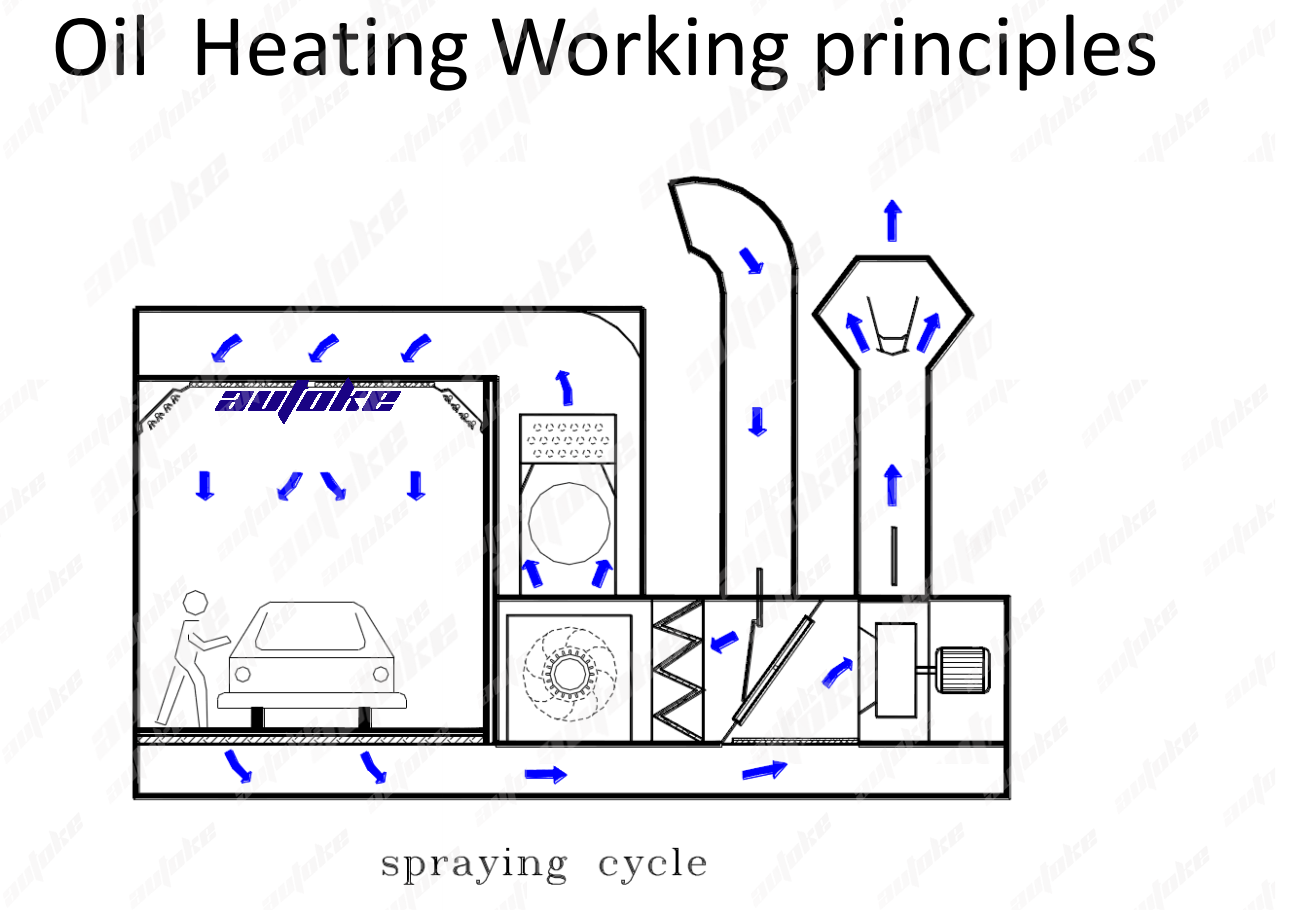
During the baking stage, the spray booth switches to a high-efficiency hot air circulation mode.
- Heating System Activation
The burner system (diesel, gas, or electric) heats the air through a heat exchanger, preventing open flames from entering the spray area and improving safety.
- Hot Air Recirculation
Heated air continuously circulates inside the booth, creating a stable, high-temperature environment that allows paint films to cure evenly and quickly.
Typical baking temperature range: 60–80°C
- Fresh Air Compensation
A small amount of fresh air is introduced during circulation to prevent excessive solvent concentration and ensure operational safety and environmental compliance.
4. Main Components of a Spray Booth Air Circulation System
A complete spray booth air circulation system typically includes:
-
Fresh air filtration system
-
Supply air fan
-
Exhaust fan
-
Floor grilles and paint mist filtration system
-
Heat exchanger (diesel or gas heating)
-
Air damper switching system
-
Intelligent control system
Specific configurations depend on booth volume, curing temperature, and baking time requirements.
5. Advantages of a Well-Designed Air Circulation System
-
Smoother paint surfaces and more uniform color
-
Reduced defects and repainting
-
Higher working efficiency and shorter cycle times
-
Lower energy consumption and operating costs
-
Improved safety and overall system reliability
6. Conclusion
The spray booth air circulation system is not only the “breathing system” of a spray booth but also the core factor determining paint quality and production efficiency.
Choosing a system with a well-designed airflow structure, scientifically engineered duct layout, and precise control is essential for creating a high-quality, stable, and efficient spray painting environment.
FAQ – Spray Booth Air Circulation System
Q1: Why is the air circulation system important in a spray booth?
A stable air circulation system ensures clean air during spraying and uniform airflow during baking, directly affecting paint finish quality and curing performance.
Q2: What airflow speed is recommended for spray booth painting?
In most professional spray booths, an airflow speed of 0.25–0.30 m/s provides optimal balance between paint mist removal and surface stability.
Q3: What is the difference between downdraft and semi-downdraft airflow systems?
Downdraft systems move air from ceiling to floor for maximum cleanliness, while semi-downdraft systems balance performance and installation cost.
Q4: How does the filtration system affect paint quality?
Multi-stage filtration removes dust and paint mist particles, reducing surface defects and repainting caused by contamination.
Q5: Does air recirculation help reduce energy consumption?
Yes. By recirculating part of the heated air during baking, the system maintains safety while significantly lowering energy usage.
Contact Us
If you are planning to build or upgrade a spray booth system, feel free to contact us for technical consultation, airflow design suggestions, or a customized spray booth solution.
Our team is ready to support your project with professional advice and reliable equipment.